2026 Guide to Distributed Home Automation Networks
Setting up a distributed home automation network in 2026 is crucial for achieving unparalleled reliability and extensive coverage across all smart devices, ensuring a seamless and efficient smart home ecosystem.
Welcome to the forefront of smart living in 2026. As our homes become increasingly intelligent, the backbone supporting these innovations—the home automation network—demands more than just basic connectivity. This guide delves into The 2026 Guide to Setting Up a Distributed Home Automation Network for Enhanced Reliability and Coverage., offering insights and strategies to build a robust, future-proof system that ensures every smart device communicates flawlessly, no matter its location.
Understanding distributed network architecture in 2026
The concept of a distributed network has evolved significantly by 2026, moving beyond simple Wi-Fi extenders to intelligent, self-healing mesh systems. This architecture is designed to eliminate single points of failure and provide ubiquitous coverage, which is paramount for the ever-growing number of smart devices in modern homes. Unlike traditional hub-and-spoke models, where a central hub can become a bottleneck or a single point of failure, a distributed network spreads intelligence and connectivity across multiple nodes.
In 2026, this means that if one part of your network experiences an issue, other parts can seamlessly take over, maintaining the integrity of your smart home operations. This redundancy is not just about convenience; it’s about ensuring critical systems, like security cameras or environmental controls, remain operational without interruption. The move towards distributed intelligence also allows for more localized processing, reducing latency and improving responsiveness for devices that require quick reactions, such as smart locks or motion sensors.
The evolution of mesh networks
Mesh networks form the core of distributed home automation in 2026. These systems consist of multiple devices that act as access points, creating a single, unified network that blankets your entire home. Each device, or node, communicates with others, forming a web of connectivity that is both resilient and scalable. This approach is starkly different from older Wi-Fi setups, where range extenders often created separate networks, leading to connection drops and configuration headaches.
- Self-healing capabilities: If a node goes offline, the network automatically reroutes traffic through other available nodes, minimizing downtime.
- Seamless roaming: Devices can move freely throughout the home without reconnecting, maintaining continuous connectivity.
- Scalability: Easily expand coverage by adding more nodes, making it ideal for homes of any size or layout.
- Improved bandwidth: Traffic is distributed across multiple paths, reducing congestion and improving overall network performance.
The embrace of distributed network architecture in 2026 is a direct response to the increasing demands of smart homes. It offers a future-proof foundation that can adapt to new technologies and device types, ensuring your smart home remains efficient and reliable for years to come.
Key components for a robust distributed network
Building a robust distributed home automation network in 2026 requires careful selection and integration of several key components. These elements work in concert to provide the reliability, coverage, and performance that modern smart homes demand. Understanding each component’s role is essential for designing an effective system that meets your specific needs.
At the heart of any distributed network are intelligent routers and mesh nodes. These devices are equipped with advanced processing power and multiple radio bands (2.4 GHz, 5 GHz, and increasingly 6 GHz for Wi-Fi 6E/7) to handle high data traffic and numerous simultaneous connections. Beyond just providing internet access, they often include built-in smart home hubs, supporting various protocols like Zigbee, Z-Wave, Thread, and Matter, which are critical for device interoperability.
Choosing the right mesh system
Selecting the optimal mesh system is the first critical step. Considerations extend beyond just brand names to include protocol support, processing power, and future-proofing capabilities. A system that supports the latest Wi-Fi standards (Wi-Fi 7 is becoming prevalent) and multiple smart home protocols will provide the best foundation.
- Wi-Fi 7 compatibility: Ensures the fastest speeds and lowest latency for bandwidth-intensive applications and future devices.
- Multi-protocol hub integration: Look for systems that natively support Zigbee, Z-Wave, Thread, and Matter to reduce the need for separate hubs.
- Advanced security features: Built-in firewalls, intrusion detection, and automatic firmware updates are crucial for protecting your smart home.
- Guest network capabilities: Isolate guest devices from your main smart home network for enhanced security.
Beyond the core mesh system, other components play vital roles. Power-over-Ethernet (PoE) switches can simplify installations for wired nodes and devices, providing both data and power through a single cable. Network attached storage (NAS) devices are increasingly integrated for local storage of security footage, media, and even local AI processing for smart home routines, reducing reliance on cloud services.
Finally, uninterruptible power supplies (UPS) for critical network components and hubs are non-negotiable in 2026. A brief power outage shouldn’t bring your entire smart home to a halt. A UPS ensures that essential services, like security monitoring and network connectivity, remain active for a period, allowing for graceful shutdowns or continued operation until power is restored. Thoughtful selection of these components ensures your distributed network is not just functional, but truly resilient and high-performing.
Strategic placement for optimal coverage and reliability
Achieving optimal coverage and reliability in your distributed home automation network hinges significantly on the strategic placement of your mesh nodes and smart devices. Even the most advanced hardware can underperform if not positioned correctly within your home’s unique layout. The goal is to create a seamless blanket of connectivity, eliminating dead zones and ensuring strong, stable signals for every device.
Begin by mapping out your home’s floor plan, identifying areas with weak signals or where smart devices are concentrated. Pay particular attention to multi-story homes, where signal penetration can be challenging, and areas with potential interference sources like large metal appliances or thick concrete walls. The central node of your mesh system, often connected directly to your internet service, should ideally be placed in a central location on the main floor to maximize its initial reach.
Best practices for node placement
Effective node placement is more art than science, but several guidelines can significantly improve your network’s performance. The objective is to ensure that each node can communicate effectively with its neighbors and cover its designated area without excessive overlap or gaps.
- Line of sight: Whenever possible, place nodes where they have a clear line of sight to other nodes and critical smart devices.
- Elevation: Elevate nodes to about waist or chest height to avoid signal absorption by furniture and floor-level obstructions.
- Avoid interference: Keep nodes away from microwaves, cordless phones, and large metal objects that can disrupt wireless signals.
- Strategic spacing: Place nodes close enough to maintain strong communication, but not so close that they are redundant. Most mesh systems recommend spacing nodes roughly 30-50 feet apart, depending on your home’s construction.
For smart devices themselves, consider their specific connectivity needs. Devices relying on lower-power protocols like Zigbee or Z-Wave often benefit from being closer to their nearest hub or repeater. Many such devices can also act as repeaters themselves, extending the network’s reach for other similar devices. Incorporating smart plugs that double as Zigbee/Z-Wave repeaters can be an incredibly effective way to bolster coverage in tricky areas.
Regularly monitoring your network’s signal strength and device connectivity through your mesh system’s app or web interface is also crucial. This allows you to identify and address potential weak spots proactively, fine-tuning node placement for continuous optimal performance. Strategic placement transforms a collection of devices into a truly integrated and reliable distributed network.
Integrating diverse smart home protocols in 2026
In 2026, the smart home landscape is characterized by a rich tapestry of communication protocols, each designed for specific purposes. Successfully integrating these diverse standards—such as Wi-Fi, Zigbee, Z-Wave, Thread, and Matter—into a cohesive distributed network is paramount for a truly versatile and future-proof smart home. The challenge lies in ensuring seamless interoperability and communication across all devices, regardless of their underlying protocol.
Modern distributed network systems often feature multi-protocol hubs embedded directly into their mesh nodes. This consolidation simplifies setup and management, allowing a single network to communicate with a wide array of smart devices. Matter, in particular, has emerged as a unifying standard, acting as an application layer that sits atop various underlying network technologies (Wi-Fi, Thread, Ethernet) to enable cross-platform compatibility.
Leveraging Matter and Thread for enhanced integration
Matter and Thread are game-changers for smart home integration in 2026. Thread provides a self-healing, low-power mesh network for devices, while Matter provides the universal language for these devices to communicate, regardless of brand or ecosystem.
- Matter-enabled devices: Prioritize devices that support Matter, as they offer guaranteed interoperability with other Matter-certified products and platforms.
- Thread Border Routers: Many modern mesh Wi-Fi systems and smart speakers now function as Thread Border Routers, allowing Thread devices to connect to your broader IP network.
- Reduced latency: Thread’s mesh architecture offers low-latency communication, ideal for responsive devices like smart switches and sensors.
- Enhanced security: Matter builds on strong security foundations, ensuring encrypted and authenticated communication between devices.
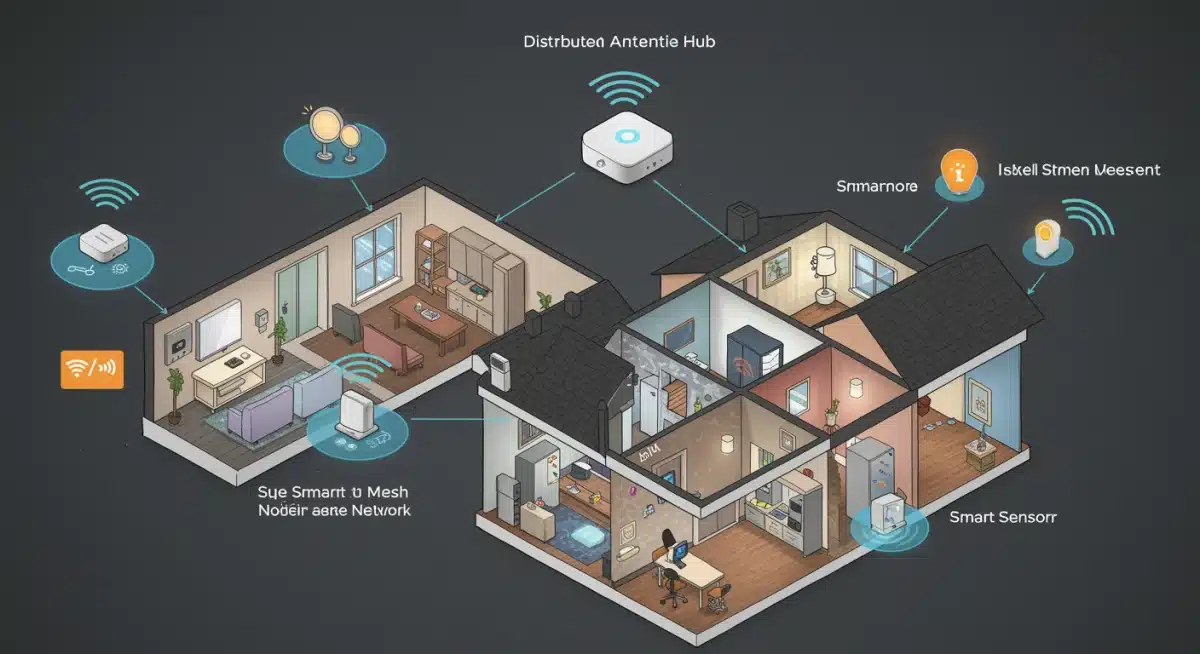
For devices still relying on Zigbee or Z-Wave, ensure your primary hub or mesh nodes have built-in support for these protocols. If not, dedicated Zigbee or Z-Wave USB sticks connected to a compatible device (like a Raspberry Pi running Home Assistant) or dedicated bridge devices can bridge the gap. The goal is to minimize the number of separate hubs, centralizing control as much as possible within your distributed network. This integrated approach not only simplifies management but also enhances the overall reliability and responsiveness of your smart home, allowing devices from different manufacturers to work together harmoniously in complex automation routines.
Advanced security and privacy in distributed networks
As distributed home automation networks become more sophisticated in 2026, so does the imperative for robust security and privacy measures. With an increasing number of interconnected devices, the attack surface expands, making it crucial to implement multi-layered defenses. Protecting your network from unauthorized access, data breaches, and malicious attacks is as important as ensuring its functionality and coverage.
Modern mesh systems come equipped with advanced security features, including WPA3 encryption, automatic firmware updates, and built-in intrusion detection. However, homeowner vigilance remains the first line of defense. Strong, unique passwords for every device and network segment are non-negotiable. Regular security audits of your network and connected devices should be a standard practice to identify and rectify potential vulnerabilities.
Implementing network segmentation and VPNs
Network segmentation is a powerful strategy for enhancing security in a distributed home automation network. By creating separate virtual local area networks (VLANs), you can isolate different types of devices, preventing a compromise in one segment from affecting the entire network.
- IoT VLAN: Isolate all smart home devices (lights, sensors, cameras) on a dedicated VLAN, limiting their access to the internet and other sensitive devices.
- Guest VLAN: Provide guests with internet access without exposing your primary smart home or personal devices.
- Admin VLAN: Reserve a secure VLAN for network management devices and sensitive personal data.
- VPN integration: Utilize a VPN (Virtual Private Network) on your router or specific devices to encrypt all outgoing traffic, enhancing privacy and security, especially for remote access to your smart home.
Beyond technical configurations, understanding the privacy implications of your smart devices is vital. Review the privacy policies of manufacturers and opt for devices that offer local processing capabilities where possible, reducing reliance on cloud services. Regularly audit which devices have access to your personal data and disable unnecessary permissions. In 2026, a secure and private distributed home automation network is not just a luxury; it’s a fundamental requirement for peace of mind and data protection.
Troubleshooting and maintenance for continuous performance
Even the most meticulously designed distributed home automation network will occasionally require troubleshooting and regular maintenance to ensure continuous, peak performance. Proactive measures and a systematic approach to problem-solving can prevent minor glitches from escalating into significant disruptions, preserving the reliability and coverage you’ve worked to establish.
One of the most common issues in any wireless network is signal interference. This can stem from new electronics, neighboring Wi-Fi networks, or even physical obstructions. Regularly checking your mesh system’s application for signal strength reports and channel utilization can help identify potential interference sources. Most modern mesh systems offer tools to automatically optimize channels, but manual intervention might sometimes be necessary.
Essential maintenance practices
Adopting a routine maintenance schedule is critical for the longevity and efficiency of your distributed network. These practices are designed to keep your system running smoothly and identify potential problems before they impact your smart home experience.
- Firmware updates: Always keep your mesh router, nodes, and smart devices updated with the latest firmware. Updates often include security patches, bug fixes, and performance enhancements.
- Network audit: Periodically review all connected devices. Remove any unknown or unused devices to reduce network clutter and potential security risks.
- Signal strength checks: Use your mesh system’s app to monitor signal strength throughout your home. If a node consistently shows weak connections, consider adjusting its placement.
- Power cycling: Occasionally power cycling (turning off and on) your router and mesh nodes can resolve minor connectivity issues and refresh network caches.
For more persistent issues, a structured troubleshooting approach is beneficial. Start by isolating the problem: Is it affecting a single device, a specific area, or the entire network? Check the device’s power, network connection, and app settings. If the issue is widespread, examine the central router and mesh nodes. Consulting manufacturer support documentation or online community forums can also provide valuable insights and solutions for complex problems. Consistent maintenance and a methodical approach to troubleshooting will keep your distributed home automation network operating flawlessly.
Future-proofing your distributed network for 2026 and beyond
In the rapidly evolving landscape of smart home technology, future-proofing your distributed network in 2026 is not merely an advantage; it’s a necessity. The goal is to build a system that can readily adapt to new standards, integrate emerging devices, and support advanced functionalities without requiring a complete overhaul every few years. This forward-thinking approach ensures your investment remains relevant and capable for the foreseeable future.
Key to future-proofing is selecting hardware that supports the latest communication standards and has ample processing power. As mentioned earlier, Wi-Fi 7 is becoming standard, offering unprecedented speeds and efficiency. Similarly, devices that support Matter and Thread are crucial, as these protocols are designed to unify the smart home ecosystem and provide a common language for devices to communicate, ensuring broader compatibility down the line.
Scalability and adaptability
An easily scalable and adaptable network is inherently future-proof. Consider systems that allow for modular expansion, letting you add more mesh nodes or specialized hubs as your smart home grows.
- Modular mesh systems: Choose systems where additional nodes can be easily added to expand coverage and capacity.
- Open-source platforms: Integrating platforms like Home Assistant provides flexibility and control, allowing you to incorporate a vast array of devices and create complex automations that might not be supported by proprietary systems.
- Edge computing capabilities: Look for network hardware or companion devices that can perform local processing. This reduces reliance on cloud services, improves privacy, and ensures faster response times, which will be increasingly important for AI-driven smart home features.
- Software-defined networking (SDN): While more advanced, some professional-grade distributed systems are adopting SDN principles, offering greater flexibility in managing network resources and adapting to new traffic patterns.
Investing in devices with over-the-air (OTA) update capabilities is also vital. This ensures that your hardware can receive software improvements, security patches, and even new features long after purchase, extending its lifespan and utility. Future-proofing your distributed home automation network in 2026 means building a flexible, robust, and intelligent foundation that can embrace the innovations yet to come, ensuring your smart home remains at the cutting edge of technology.
| Key Aspect | Brief Description |
|---|---|
| Distributed Architecture | Employs mesh networks for ubiquitous coverage and redundancy, eliminating single points of failure. |
| Protocol Integration | Combines Wi-Fi, Zigbee, Z-Wave, Thread, and Matter for seamless device interoperability and control. |
| Security & Privacy | Implements WPA3, network segmentation (VLANs), and VPNs to protect against threats. |
| Future-Proofing | Focuses on Wi-Fi 7, Matter, Thread, modularity, and OTA updates for long-term relevance. |
Frequently asked questions about distributed home automation
A distributed home automation network uses multiple interconnected nodes, often in a mesh configuration, to extend wireless coverage and ensure robust connectivity throughout a home. This architecture minimizes signal dead zones and provides redundancy, meaning if one node fails, others can maintain network functionality for smart devices.
Traditional routers often struggle with extensive coverage in larger or multi-story homes, leading to dead zones. Distributed networks, especially mesh systems, provide a single, unified network that blankets the entire property, offering more consistent signal strength, better reliability, and seamless roaming for all smart devices, enhancing overall performance.
Matter acts as a universal application layer, allowing smart devices from different manufacturers and ecosystems to communicate seamlessly over various underlying network technologies like Wi-Fi and Thread. This significantly simplifies device integration, reduces compatibility issues, and enables more complex, unified automation routines across your distributed network.
Essential security measures include using strong, unique passwords, enabling WPA3 encryption, regularly updating firmware, and implementing network segmentation (VLANs) to isolate IoT devices. Additionally, considering a VPN for remote access and performing periodic security audits are crucial steps to protect your smart home.
Yes, most existing smart devices can be integrated. While newer distributed networks often support advanced protocols like Matter and Thread, many mesh systems include backward compatibility or multi-protocol hubs for Zigbee and Z-Wave. Devices relying solely on Wi-Fi will connect directly, ensuring a smooth transition and continued use of your current smart home tech.
Conclusion
Establishing a distributed home automation network in 2026 is no longer just about convenience; it’s about building a resilient, high-performing, and secure foundation for the modern smart home. By embracing mesh technology, strategically placing nodes, integrating diverse protocols like Matter and Thread, and prioritizing robust security measures, homeowners can create an intelligent living environment that offers unparalleled reliability and comprehensive coverage. The future of smart living hinges on networks that are not only connected but truly interconnected and adaptable, ready to evolve with the next wave of technological innovation.