Voice Assistant Showdown 2025: Echo vs. Nest for Home Control
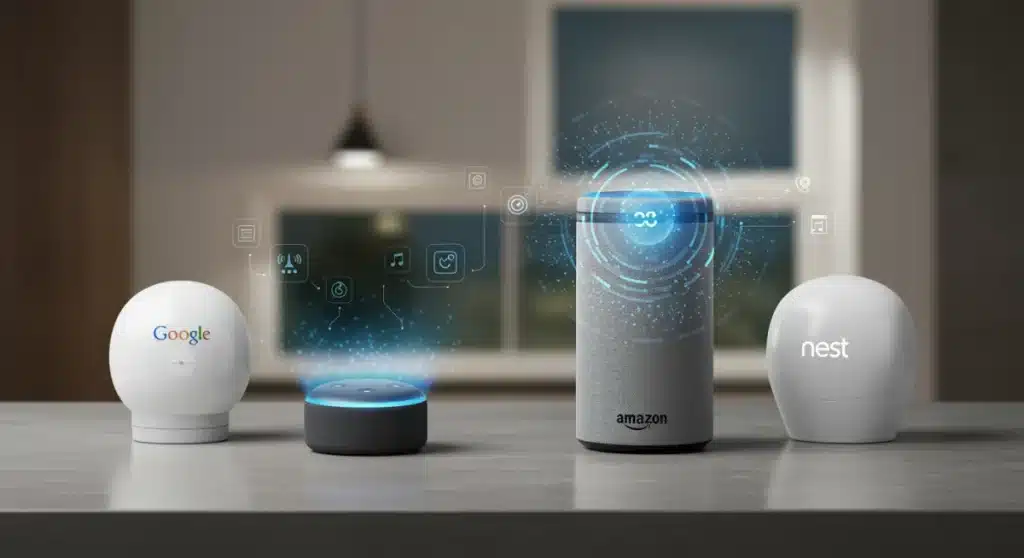
The 2025 voice assistant showdown between Amazon Echo and Google Nest reveals key differences in smart home control, offering insights into their respective ecosystems, AI capabilities, and integration strengths for consumers.
Welcome to the definitive Voice Assistant Showdown 2025: A Deep Dive into Amazon Echo vs. Google Nest for Home Control. As smart homes become increasingly sophisticated, choosing the right voice assistant is more crucial than ever. This guide will help you navigate the evolving landscape of AI-powered home management, pitting two industry giants against each other.
The Evolution of Voice Assistants: A 2025 Perspective
Voice assistants have come a long way from simple command-and-response systems. In 2025, they are the central nervous system of many smart homes, orchestrating complex routines and anticipating user needs. This evolution has been driven by advancements in artificial intelligence, machine learning, and widespread device integration.
Both Amazon Echo with Alexa and Google Nest with Google Assistant have invested heavily in creating more intuitive and proactive experiences. They are no longer just speakers; they are intelligent hubs that learn from your habits and preferences. This section explores how these platforms have matured and what new capabilities they bring to the table.
Advanced AI and Machine Learning Capabilities
The core of any voice assistant lies in its AI. In 2025, both Alexa and Google Assistant boast significantly improved natural language processing (NLP) and contextual understanding. They can handle more complex, multi-part queries and maintain conversational flow better than ever before.
- Contextual Awareness: Assistants now better understand the context of your requests, remembering previous interactions.
- Proactive Suggestions: Based on routines and learned behavior, they offer suggestions for tasks or information before you even ask.
- Emotion Recognition: Early stages of detecting user emotion to tailor responses and actions, enhancing user experience.
These enhancements mean fewer frustrations and a more seamless interaction. Users can speak more naturally, and the assistants are better equipped to interpret nuances in speech, leading to more accurate and helpful responses.
Seamless Integration with Smart Home Ecosystems
The true power of a voice assistant in 2025 is its ability to seamlessly integrate with a vast array of smart home devices. Both Amazon and Google have expanded their ecosystems to support thousands of devices from various manufacturers, creating a truly interconnected home.
- Broad Device Compatibility: Support for lighting, thermostats, security cameras, smart locks, and kitchen appliances.
- Unified Control Interfaces: Manage all connected devices through a single voice command or app.
- Cross-Platform Routines: Create complex routines that involve devices from different brands working in harmony.
The continued growth in device compatibility ensures that regardless of your preferred smart home brands, your chosen voice assistant can likely manage them. This interoperability is key to a truly smart and automated living space.
In summary, the evolution of voice assistants by 2025 showcases a leap in AI capabilities and ecosystem integration. Both Amazon Echo and Google Nest offer sophisticated control over smart homes, driven by advanced machine learning and extensive device compatibility, making them indispensable for modern living.
Amazon Echo (Alexa) in 2025: Strengths and Innovations
Amazon’s Alexa, housed within the Echo devices, continues to be a dominant force in the smart home market. By 2025, Alexa has further refined its offerings, focusing on user-centric features and expanding its reach. Its strengths lie in its vast ‘Skills’ library, robust device compatibility, and innovative privacy controls.
The Echo lineup itself has diversified, with devices tailored for every room and need, from compact smart speakers to advanced smart displays with integrated home hubs. Amazon’s continuous innovation aims to keep Alexa at the forefront of the voice assistant race.
Alexa’s Expanding ‘Skills’ and Customization
One of Alexa’s long-standing advantages is its extensive library of ‘Skills’ – third-party applications that extend its functionality. In 2025, this library has grown exponentially, offering specialized tools for productivity, entertainment, health, and more. Users can now create even more personalized experiences.
Customization options have also deepened, allowing users to tailor Alexa’s responses, create complex routines with greater ease, and even personalize its voice. This level of personalization makes Alexa feel more like a bespoke assistant rather than a generic AI.
Privacy and Security Enhancements
Recognizing growing user concerns, Amazon has made significant strides in privacy and security for Alexa in 2025. New features provide users with more control over their data and interactions, building greater trust in the platform.
- Enhanced Voice ID: More accurate voice recognition ensures personalized responses and secure access to sensitive information.
- Granular Data Controls: Users have finer control over how their voice recordings and interaction data are stored and used.
- Privacy Zones: Ability to define ‘privacy zones’ where microphones are temporarily deactivated for sensitive conversations.
These privacy enhancements are crucial for maintaining user confidence in always-on listening devices. Amazon’s commitment to transparency and user control is a key differentiator in the competitive landscape.
In summary, Amazon Echo with Alexa in 2025 stands out for its expansive ‘Skills’ ecosystem and deep customization options. Coupled with significant advancements in user privacy and security, Alexa continues to offer a powerful and personalized smart home control experience, reinforcing its position as a market leader.
Google Nest (Google Assistant) in 2025: Intelligence and Integration
Google Nest, powered by Google Assistant, offers a compelling alternative, distinguished by its exceptional AI intelligence and deep integration with Google’s vast suite of services. By 2025, Google Assistant has solidified its reputation for superior contextual understanding and proactive assistance, making it incredibly intuitive for daily use.
The Nest ecosystem, encompassing smart speakers, displays, and thermostats, is designed to work cohesively, creating a truly intelligent home environment. Google’s focus remains on leveraging its search and AI prowess to deliver an unparalleled conversational experience.
Superior Conversational AI and Contextual Understanding
Google Assistant’s strength has always been its ability to engage in natural, flowing conversations. In 2025, this capability has reached new heights. It can understand complex queries with multiple clauses and seamlessly transition between topics, making interactions feel less like commands and more like genuine conversations.
Its deep integration with Google Search means it has access to an unparalleled amount of information, allowing it to answer a broader range of questions with greater accuracy and detail. This intelligence is a significant draw for users who prioritize information retrieval and nuanced interaction.
Deep Integration with Google Services and Android
For users deeply embedded in the Google ecosystem, Google Assistant offers unmatched integration. From calendars and emails to YouTube and Google Maps, the assistant seamlessly pulls information and performs actions across various Google services.
- Calendar and Email Management: Effortlessly manage your schedule, set reminders, and dictate emails.
- Personalized Information: Get tailored news, traffic updates, and flight information based on your Google account.
- Android Device Synergy: Unparalleled control and synchronization with Android smartphones and tablets.
This deep integration extends to Android devices, providing a unified experience whether you’re at home or on the go. The synergy between your phone and your smart home devices creates a powerful and convenient ecosystem.
In conclusion, Google Nest and its Assistant in 2025 excel with their superior conversational AI and extensive integration with Google’s services. This intelligence, combined with seamless connectivity across the Google ecosystem, offers users a highly personalized and efficient smart home experience, especially for Android users.
Smart Home Control: A Direct Comparison for 2025
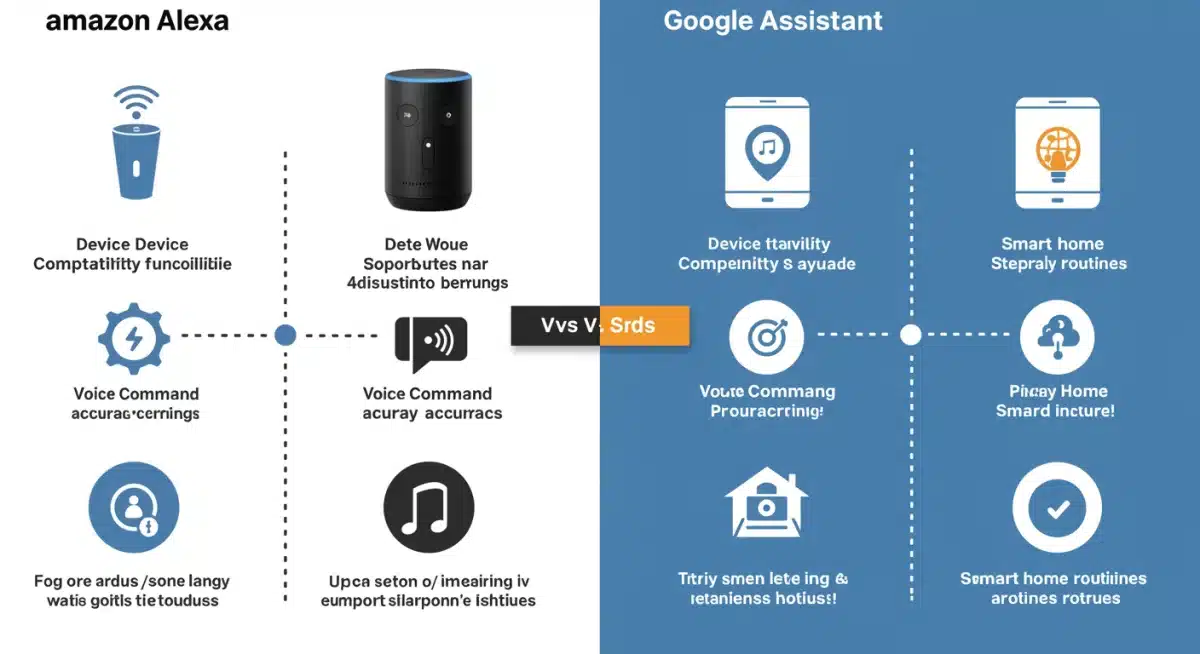
When it comes to direct smart home control, both Amazon Echo and Google Nest offer comprehensive solutions, but with slightly different philosophies. Understanding these differences is key to determining which platform best suits your specific needs and existing smart home setup. Both platforms have matured significantly, offering intuitive interfaces and robust automation capabilities.
The choice often boils down to which ecosystem’s approach to device management, routine creation, and overall user experience aligns more closely with your preferences. This section will highlight the practical distinctions in their smart home control capabilities.
Device Compatibility and Ecosystem Breadth
Both Alexa and Google Assistant boast impressive lists of compatible devices. However, there are subtle differences in their strengths. Alexa often has a slight edge in sheer number of supported devices, particularly in niche smart home categories, thanks to its longer presence in the market and broader third-party developer support.
Google Assistant, while also supporting a vast array of devices, tends to shine with products that are part of the ‘Works with Google Home’ program, often offering deeper integration and more advanced features within that specific ecosystem. For users with a mixed bag of smart devices, checking specific compatibility is always recommended.
Routine Creation and Automation Flexibility
Creating automated routines is a cornerstone of any smart home. Both platforms offer robust tools for setting up sequences of actions based on triggers like time, voice commands, or sensor activity. Alexa’s ‘Routines’ and Google Assistant’s ‘Routines’ are powerful, but their interfaces and advanced options differ.
- Alexa Routines: Often praised for their straightforward setup and a wide range of triggers and actions, including custom voice phrases.
- Google Assistant Routines: Excel in conditional logic and integration with personal data like calendar events and commute times, offering more intelligent, context-aware automations.
- Third-Party Integrations: Both platforms support IFTTT (If This Then That) for even more complex cross-platform automations.
The choice between them often comes down to whether you prefer Alexa’s broad and easily accessible routine options or Google Assistant’s more intelligent, data-driven automation capabilities.
User Interface and Voice Command Accuracy
The user interface, particularly for smart displays, and the accuracy of voice commands are critical for daily interaction. Alexa’s smart displays (Echo Show) offer a touch-friendly interface with visual feedback for many commands, making them very intuitive for device control and media consumption.
Google Nest Hub devices, on the other hand, leverage Google’s expertise in visual search and information display, often providing more comprehensive answers and richer visual content. Both have achieved high levels of voice command accuracy by 2025, though Google Assistant often slightly outperforms in understanding complex, multi-layered requests due to its advanced NLP.
To summarize, the smart home control capabilities of Amazon Echo and Google Nest in 2025 are both highly advanced. While Alexa may offer broader device compatibility and simpler routine creation, Google Assistant excels in intelligent automations and superior conversational AI, making the choice dependent on individual user priorities and existing smart home ecosystems.
Privacy and Data Handling: A Critical Look at 2025 Standards
As voice assistants become more deeply embedded in our lives, the issues of privacy and data handling have escalated in importance. In 2025, both Amazon and Google have implemented stricter policies and introduced new features to address these concerns, but their approaches and transparency levels still present differences that consumers should consider carefully.
Understanding how each platform manages your personal data, voice recordings, and smart home activity is crucial for making an informed decision. This section delves into the privacy frameworks of Alexa and Google Assistant.
Amazon’s Approach to Privacy
Amazon has faced scrutiny over privacy concerns in the past, leading to significant improvements in its Alexa platform. By 2025, Alexa offers clearer controls for managing voice recordings, including options for automatic deletion and easy access to review your history. Amazon emphasizes user control through its Alexa Privacy Hub.
- Voice History Management: Users can view, listen to, and delete individual voice recordings or set up automatic deletion.
- Privacy Settings Dashboard: A centralized hub to manage permissions for skills, data usage, and microphone access.
- On-Device Processing: Increased use of on-device processing for common commands to reduce reliance on cloud servers.
Despite these advancements, Amazon’s business model relies heavily on data for personalized recommendations and advertising, which remains a consideration for privacy-conscious users. The company continues to refine its privacy features based on user feedback and regulatory requirements.
Google’s Approach to Privacy
Google, with its extensive data collection across numerous services, also places a strong emphasis on privacy controls for Google Assistant. In 2025, Google has enhanced its ‘My Activity’ dashboard, offering comprehensive tools to review and manage all interactions with the Assistant. Google’s commitment to anonymization and data minimization is a key part of their strategy.
- Activity Controls: Users can pause or automatically delete their Google Assistant activity across all devices.
- Guest Mode: A temporary mode that allows guests to use Nest devices without their activity being saved to your Google account.
- Privacy Checkup: Regular prompts and tools to review and adjust privacy settings for all Google services.
Google’s approach often integrates privacy controls across its broader ecosystem, making it easy for users to manage their data from a single point. This holistic view of user data is both a strength and a potential concern, depending on individual comfort levels.
In summary, both Amazon Echo and Google Nest have made significant strides in privacy and data handling by 2025. While Amazon focuses on granular control over voice recordings and on-device processing, Google leverages its comprehensive activity controls and ecosystem-wide privacy management. Consumers must weigh these approaches against their personal privacy preferences.
User Experience and Ecosystem Lock-in in 2025
Beyond technical specifications and privacy policies, the overall user experience and the degree of ecosystem lock-in are crucial factors in choosing a voice assistant. In 2025, both Amazon and Google have cultivated distinct user experiences that cater to different preferences, often leading to a natural gravitation towards one ecosystem over the other.
Understanding these subtle differences in daily interaction, content consumption, and the implications of committing to one platform can significantly influence long-term satisfaction. This section explores the qualitative aspects of using Echo and Nest devices.
Amazon Echo: Content, Shopping, and Entertainment
The Amazon Echo ecosystem, naturally, has a strong integration with Amazon’s vast array of services, including Prime Video, Amazon Music, and, most notably, Amazon Shopping. This makes Alexa an incredibly convenient tool for managing your Amazon-related activities, from reordering household essentials to tracking packages.
- Seamless Shopping: Voice purchasing and reordering items from Amazon is effortless.
- Entertainment Hub: Deep integration with Amazon Music, Audible, and other streaming services.
- Richer Media Experience: Echo Show devices excel as media consumption hubs, offering a wide array of visual content.
For users who are already heavily invested in Amazon’s services, the Echo offers a highly cohesive and convenient experience. The focus on entertainment and e-commerce is a clear differentiator.
Google Nest: Information, Productivity, and Android Synergy
Google Nest, with Google Assistant, shines in its ability to deliver information, enhance productivity, and seamlessly integrate with the Android operating system. Its strengths lie in providing quick, accurate answers to complex questions, managing schedules, and offering personalized assistance based on your Google account.
- Knowledge at Your Fingertips: Leveraging Google Search for unparalleled information retrieval.
- Productivity Powerhouse: Excellent for managing calendars, setting reminders, and coordinating tasks.
- Android Integration: Unmatched synergy with Android phones, enhancing continuity between devices.
For users who prioritize information access, productivity tools, and a unified experience across their Google and Android devices, the Nest ecosystem provides a highly efficient and intelligent environment. The emphasis here is on being an ultimate personal assistant.
In summary, the user experience for Amazon Echo in 2025 leans heavily into entertainment, shopping, and Amazon services, offering a convenient hub for these activities. Google Nest, conversely, focuses on information access, productivity, and deep integration with the Google and Android ecosystems, making it ideal for users who rely heavily on these services. Both create a degree of ecosystem lock-in, influencing future smart home purchases.
Future Outlook: What’s Next for Voice Assistants in Smart Homes?
Looking beyond 2025, the trajectory for voice assistants in smart homes points towards even greater autonomy, predictive intelligence, and personalized interactions. The competition between Amazon Echo and Google Nest will continue to drive innovation, pushing the boundaries of what these devices can do for us.
The future promises a world where our homes are not just smart, but truly intelligent, anticipating our needs and optimizing our environments without explicit commands. This section explores the emerging trends and potential breakthroughs.
Proactive and Predictive Intelligence
The next frontier for voice assistants is moving from reactive to proactive. Future versions of Alexa and Google Assistant will likely exhibit even more advanced predictive capabilities, using machine learning to anticipate your needs based on patterns, external data (weather, traffic), and even biometric inputs.
- Anticipatory Routines: Your home might adjust lighting and temperature based on your commute home before you even leave work.
- Personalized Wellness: Integration with wearables to suggest health-related actions, like reminding you to hydrate or offering guided meditation.
- Energy Optimization: Proactively managing energy consumption based on learned habits and real-time energy prices.
This shift towards proactive assistance will make smart homes feel even more integrated and responsive, reducing the need for constant interaction and allowing the technology to fade into the background.
Enhanced Multimodal Interaction and Ambient Computing
While voice remains central, future interactions will become increasingly multimodal. This means seamless transitions between voice, touch, gesture, and even gaze, creating a more natural and intuitive user experience. Ambient computing, where technology is embedded everywhere and responds intelligently, is the ultimate goal.
- Voice and Visual Synergy: Smart displays will offer more sophisticated visual interfaces that complement voice commands, allowing for richer data presentation.
- Gesture Control: Subtle hand gestures could control devices without needing to speak or touch.
- Ubiquitous Sensors: Homes filled with intelligent sensors that feed data to the voice assistant for a truly ambient experience.
The vision is for a home that understands and adapts to you, rather than you having to constantly adapt to it. This will make smart home technology accessible and beneficial to an even wider audience.
Interoperability and Open Standards
Despite the current ecosystem rivalry, there’s a growing push for greater interoperability and open standards (like Matter) in the smart home industry. This trend suggests a future where devices from different manufacturers and platforms can communicate seamlessly, reducing vendor lock-in and simplifying the user experience.
While Amazon and Google will continue to compete fiercely, their investments in open standards will ultimately benefit consumers, allowing for greater flexibility and choice in building their smart homes. This collaborative competition will accelerate innovation across the board.
In conclusion, the future of voice assistants in smart homes beyond 2025 promises a landscape of proactive intelligence, enhanced multimodal interactions, and greater interoperability. Both Amazon Echo and Google Nest are poised to evolve into even more sophisticated and integrated systems, making our homes not just smart, but truly intuitive and responsive to our every need.
| Key Feature | Description |
|---|---|
| AI Intelligence | Google Assistant excels in contextual understanding and complex conversational AI. |
| Ecosystem Strength | Amazon Echo offers broader device compatibility and extensive ‘Skills’ library. |
| Privacy Controls | Both platforms offer robust controls, with Amazon focusing on voice data, Google on activity. |
| User Experience | Echo favors shopping/entertainment; Nest prioritizes information/productivity. |
Frequently Asked Questions About Voice Assistants in 2025
In 2025, Amazon Echo (Alexa) shines in device compatibility, its vast ‘Skills’ library, and seamless Amazon service integration. Google Nest (Assistant) excels in conversational AI, contextual understanding, and deep connections with Google services and Android devices, offering a more intelligent personal assistant experience.
While both support thousands of devices, Amazon Echo traditionally has a slight edge in the sheer number of supported third-party smart home devices due to its longer market presence. Google Nest focuses on deeper integration with ‘Works with Google Home’ certified products. Always check specific device compatibility.
By 2025, both Amazon and Google have significantly enhanced privacy controls. Amazon offers granular voice recording management and privacy zones. Google provides comprehensive activity controls and a guest mode. Both aim for transparency and user control over data, addressing past concerns.
Alexa Routines are generally lauded for their user-friendliness and wide range of triggers. Google Assistant Routines, however, often offer more advanced conditional logic and intelligent automations, particularly when integrating with personal data like calendars and commute times, making them highly context-aware.
Future trends beyond 2025 include more proactive and predictive intelligence, where assistants anticipate needs. We also expect enhanced multimodal interactions combining voice, touch, and gestures, alongside greater interoperability through open standards like Matter, creating truly ambient and intuitive smart homes.
Conclusion
The Voice Assistant Showdown 2025: A Deep Dive into Amazon Echo vs. Google Nest for Home Control reveals two highly capable, yet distinct, smart home ecosystems. Amazon Echo, powered by Alexa, continues to excel with its extensive device compatibility, a vast library of ‘Skills,’ and strong integration with Amazon’s shopping and entertainment services. It’s an ideal choice for users deeply embedded in the Amazon ecosystem and those prioritizing broad connectivity. Conversely, Google Nest, driven by Google Assistant, stands out for its superior conversational AI, advanced contextual understanding, and seamless integration with Google’s suite of services and Android devices. It caters to users who value information retrieval, productivity, and a highly intelligent personal assistant. Both platforms have made significant advancements in privacy and offer robust smart home automation, albeit with different approaches to routine creation and user experience. Ultimately, the best choice depends on your personal preferences, existing smart home devices, and how deeply you are integrated into either Amazon’s or Google’s broader digital ecosystem. The future promises even more intelligent, proactive, and seamlessly integrated voice assistants, continually transforming how we interact with our homes.