Smart Home Integration: Automate Kitchen & Laundry for 15% Time Savings by 2026
Smart Appliance Integration: Automating Kitchen and Laundry for 15% Time Savings in 2026
In an increasingly fast-paced world, the quest for efficiency and convenience has become paramount. Our homes, once mere shelters, are rapidly evolving into intelligent ecosystems designed to anticipate our needs and simplify our lives. At the forefront of this revolution is Smart Appliance Integration, a powerful concept that promises to redefine how we interact with our living spaces, particularly in high-traffic areas like the kitchen and laundry room. Imagine a future, not too distant – specifically by 2026 – where your daily routines are seamlessly automated, saving you a remarkable 15% of your precious time. This isn’t science fiction; it’s the tangible reality that smart appliance integration is bringing to our doorsteps.
The allure of a connected home extends beyond mere novelty. It addresses a fundamental human desire: to reclaim time. Time spent on mundane chores, time lost to inefficient processes, time that could be redirected towards more fulfilling activities. By orchestrating a symphony of smart devices, from refrigerators that order groceries to washing machines that optimize cycles based on energy prices, we are moving towards a paradigm where our homes work for us, not the other way around. This comprehensive guide will delve into the transformative potential of Smart Appliance Integration, exploring its core components, the tangible benefits it offers, the technological advancements driving its adoption, and what the future holds for truly intelligent living.
The Dawn of the Connected Home: What is Smart Appliance Integration?
At its heart, Smart Appliance Integration refers to the seamless communication and coordinated operation of various smart home devices, particularly those found in the kitchen and laundry room. It moves beyond individual smart appliances working in isolation, instead focusing on creating a unified network where devices can share data, respond to user commands, and even anticipate needs autonomously. Think of it as an intelligent orchestra, where each appliance is a musician playing its part in perfect harmony, directed by a central conductor – your smart home system.
This integration is powered by the Internet of Things (IoT), a vast network of physical objects embedded with sensors, software, and other technologies for the purpose of connecting and exchanging data with other devices and systems over the internet. For smart appliances, this means your refrigerator can communicate with your smart oven, your washing machine can talk to your dryer, and all of them can be controlled and monitored via a single app or voice assistant.
The goal is not just to make appliances ‘smart’ individually, but to make them ‘smarter’ collectively. For instance, a smart refrigerator might detect that you’re running low on milk and automatically add it to your grocery list, which can then be synced with a smart shopping app. A smart washing machine could automatically start a cycle during off-peak electricity hours, saving energy and money, and then alert your smart dryer to prepare for the load. This level of interconnectedness transforms routine tasks from chores into automated background processes, freeing up valuable time and mental bandwidth.
The concept of Smart Appliance Integration is built upon several foundational pillars:
- Interoperability: The ability of different devices, often from various manufacturers, to work together seamlessly. This is crucial for a truly integrated smart home.
- Centralized Control: Managing all connected appliances from a single interface, whether it’s a smartphone app, a smart hub, or a voice assistant.
- Automation and Scheduling: Setting up routines and schedules for appliances to operate automatically based on predefined conditions (e.g., time of day, sensor readings, or even your location).
- Data Exchange and Analytics: Appliances collecting and sharing data to optimize performance, predict maintenance needs, and offer personalized insights into usage patterns.
As technology advances, these pillars are becoming stronger and more sophisticated, laying the groundwork for the 15% time savings we anticipate by 2026. The journey towards a fully integrated smart home is an exciting one, promising a future where convenience and efficiency are not luxuries, but standard features of our daily lives.
The Kitchen of Tomorrow: Revolutionizing Culinary Routines
The kitchen, often considered the heart of the home, is ripe for the transformative power of Smart Appliance Integration. From meal preparation to cleanup, every step can be optimized, streamlined, and in many cases, automated. The benefits extend far beyond mere convenience, impacting everything from food waste to energy consumption.
Smart Refrigerators: More Than Just Cooling
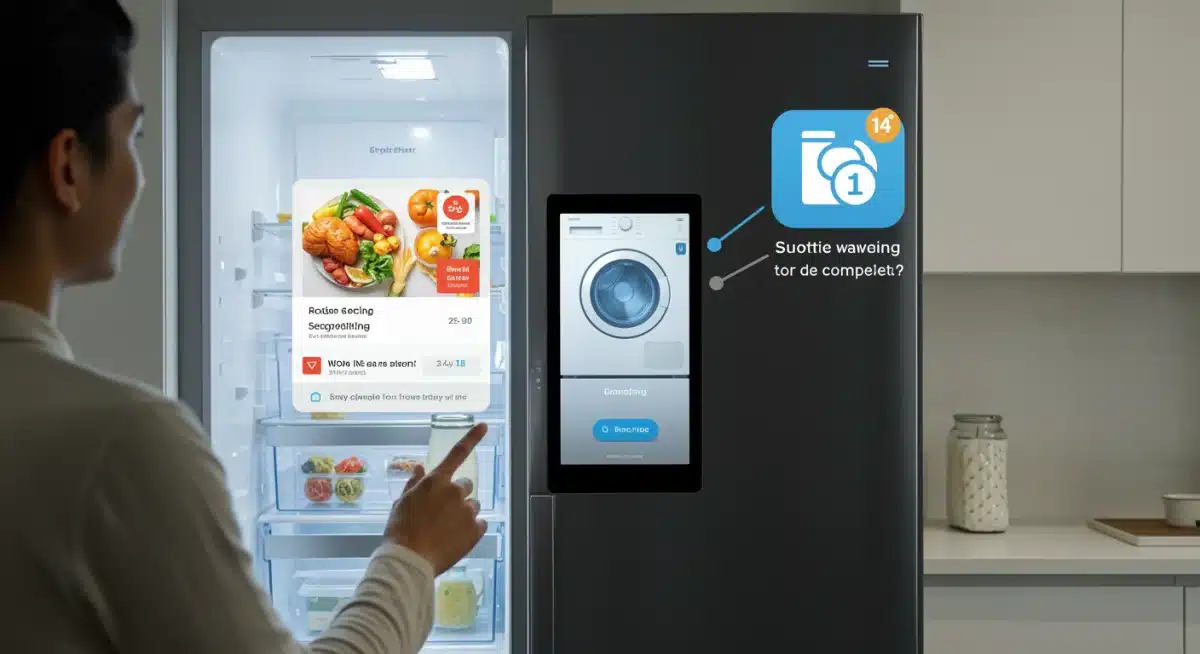
Modern smart refrigerators are evolving into central hubs for kitchen management. They can:
- Track Inventory: Internal cameras allow you to see what’s inside your fridge from anywhere, preventing unnecessary purchases and reducing food waste.
- Suggest Recipes: Based on available ingredients and dietary preferences, they can recommend recipes, often sending cooking instructions directly to a smart oven.
- Automate Shopping Lists: As items run low, they can automatically add them to a digital shopping list or even place orders with online grocery services.
- Monitor Expiration Dates: Alerts can be sent for items nearing their expiration, prompting timely consumption.
Smart Ovens and Cooktops: Precision and Convenience
Gone are the days of constantly checking on your food. Smart ovens and cooktops offer:
- Remote Control and Preheating: Start preheating your oven on your way home from work, ensuring it’s ready when you walk through the door.
- Guided Cooking: Follow recipes with step-by-step instructions displayed on a built-in screen, often adjusting temperature and cooking time automatically.
- Temperature Probes: Monitor internal food temperature precisely, guaranteeing perfectly cooked meals every time.
- Self-Cleaning and Maintenance Alerts: Schedule cleaning cycles and receive notifications for routine maintenance, extending appliance lifespan.
Smart Dishwashers: Sparkling Clean, Optimal Efficiency
Dishwashers are also joining the integrated network, offering:
- Remote Start and Monitoring: Start a cycle from your phone, and receive notifications when it’s complete.
- Load Sensing: Automatically adjust water usage and cycle length based on the dirtiness and size of the load, saving water and energy.
- Detergent Dispensing: Some models can automatically dispense the correct amount of detergent, or even reorder it when supplies are low.
The integration of these devices means a smart refrigerator can tell your oven the perfect temperature for a recipe, which then alerts your dishwasher to prepare for cleanup. This seamless flow of information minimizes manual intervention, drastically cutting down on the time and effort traditionally associated with kitchen tasks. The cumulative effect of these small, automated efficiencies is the significant time savings we’re targeting.
The Laundry Room Reinvented: Efficiency and Effortless Care
Beyond the kitchen, the laundry room is another prime candidate for substantial time savings through Smart Appliance Integration. The days of constantly checking on cycles, remembering to transfer clothes, or dealing with unexpected delays are quickly becoming a thing of the past. Smart washers and dryers are transforming this often-dreaded chore into a simpler, more efficient process.
Smart Washing Machines: Optimized Cleaning Cycles
Modern smart washing machines are designed to offer unparalleled convenience and efficiency:
- Remote Start and Monitoring: Start a load from anywhere, ideal for busy schedules or maximizing off-peak energy rates. Receive notifications when the cycle is finished, preventing clothes from sitting too long and getting wrinkled.
- Load Sensing and Detergent Dispensing: Advanced sensors detect the size and soil level of the load, automatically adjusting water levels, cycle time, and detergent dosage for optimal cleaning and resource conservation.
- Fabric Care Optimization: Some models can identify fabric types and suggest the best wash cycle, protecting your garments and extending their lifespan.
- Diagnostic Alerts: Receive alerts for potential issues or required maintenance, often with troubleshooting tips directly on your smartphone.
Smart Dryers: Precision Drying and Energy Savings
Complementing smart washers, smart dryers ensure your clothes are dried perfectly and efficiently:
- Moisture Sensors: These sensors detect when clothes are dry, automatically stopping the cycle to prevent over-drying, which can damage fabrics and waste energy.
- Wrinkle Prevention: Tumble clothes periodically after the cycle ends to prevent wrinkles if you can’t unload them immediately.
- Cycle Synchronization: A truly integrated system allows your smart washer to communicate with your smart dryer, recommending the appropriate drying cycle based on the wash settings and load type. This eliminates guesswork and ensures optimal care.
- Vent Cleaning Reminders: Receive notifications when it’s time to clean the dryer vent, a crucial safety and efficiency measure.
Integrated Laundry Management
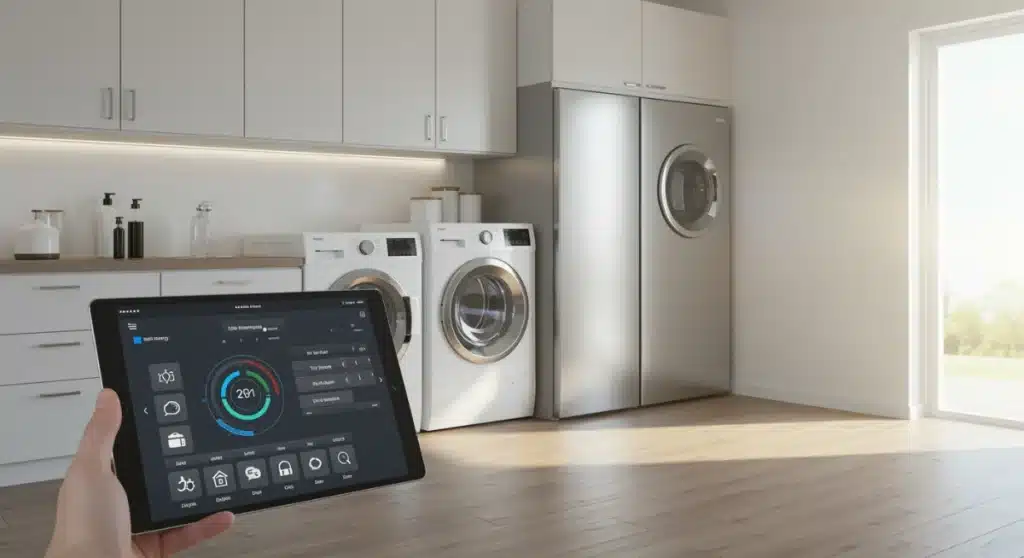
The real magic happens when these devices work together. Imagine this scenario: your smart washing machine finishes a cycle, automatically sends a notification to your phone, and simultaneously pings your smart dryer to prepare for the load. You can then remotely start the dryer from your office, knowing that it will stop precisely when the clothes are dry, preventing shrinking and saving energy. This level of automation significantly reduces the mental load and physical effort associated with laundry, contributing substantially to the targeted 15% time savings.
Furthermore, some systems can integrate with smart energy grids, allowing your appliances to automatically run during off-peak hours when electricity is cheaper, without you needing to lift a finger. This not only saves you time but also reduces your utility bills, adding another layer of value to Smart Appliance Integration.
Beyond Individual Appliances: The Power of Ecosystems and AI
While individual smart appliances offer undeniable benefits, the true power of Smart Appliance Integration lies in the creation of cohesive ecosystems. These ecosystems are often built around central smart hubs or platforms (like Apple HomeKit, Google Home, Amazon Alexa, or Samsung SmartThings) that allow diverse devices to communicate and interact, regardless of their manufacturer. This interoperability is critical for realizing the full potential of a connected home.
The Role of Smart Hubs and Voice Assistants
Smart hubs act as the brain of your integrated home, facilitating communication between devices that might use different protocols (Wi-Fi, Bluetooth, Zigbee, Z-Wave). They allow you to:
- Create Routines: Set up complex automation sequences, such as ‘Good Morning’ routines that brew coffee, turn on kitchen lights, and display your schedule.
- Voice Control: Use voice commands to manage all your integrated appliances, from preheating the oven to checking laundry status.
- Remote Access: Control and monitor your entire home from anywhere in the world via a single app.
Voice assistants, integrated into smart speakers and even directly into some appliances, provide a natural and intuitive interface for interacting with your smart home. No more fumbling with buttons or apps; a simple command can orchestrate complex tasks.
Artificial Intelligence and Machine Learning: The Future of Automation
The next frontier in Smart Appliance Integration involves the deeper application of Artificial Intelligence (AI) and Machine Learning (ML). These technologies enable appliances to learn from your habits, preferences, and environmental conditions to provide truly predictive and personalized automation.
- Predictive Maintenance: AI can analyze appliance performance data to predict potential failures before they occur, scheduling maintenance proactively and preventing costly breakdowns.
- Personalized Routines: ML algorithms can observe your daily patterns (e.g., when you typically do laundry, what you cook) and suggest or automatically implement routines that fit your lifestyle perfectly.
- Dynamic Optimization: Appliances can dynamically adjust their operation based on real-time data, such as energy prices, weather forecasts, or even your current location (e.g., preheating the oven when you’re 10 minutes from home).
- Enhanced Security: Integrated systems can detect unusual activity, such as an oven left on for too long, and send alerts or even shut down the appliance automatically.
The combination of robust ecosystems and advanced AI is what will truly unlock the 15% time savings by 2026. Your home won’t just be smart; it will be intuitive, anticipatory, and remarkably efficient, allowing you to focus on what truly matters.
Quantifying the Savings: How 15% Becomes a Reality by 2026
The promise of 15% time savings through Smart Appliance Integration might seem ambitious, but it’s a realistic goal when we break down the cumulative impact of automation across various household tasks. Let’s consider how these efficiencies add up over the course of a week, a month, and ultimately, a year.
Kitchen Time Savings Breakdown:
- Grocery Management: Automating shopping lists, inventory tracking, and even direct ordering can save 1-2 hours per month. No more last-minute runs to the store or forgotten items.
- Meal Preparation: Remote preheating, guided cooking, and recipe suggestions reduce active cooking time and mental effort. If you cook 5 times a week, saving just 10 minutes per meal totals over 3 hours a month.
- Cleanup: Smart dishwashers optimizing cycles and offering remote start can save 30 minutes to 1 hour per month in active management and waiting time.
- Food Waste Reduction: While not direct time savings, reducing food waste means less time spent planning around expiring food or throwing it away, indirectly contributing to efficiency.
Estimated Monthly Kitchen Savings: 4.5 – 7 hours
Laundry Time Savings Breakdown:
- Cycle Management: Remote start/stop, notifications, and automatic cycle adjustments eliminate constant monitoring. If you do 3-4 loads a week, saving 15 minutes per load (from checking, waiting, transferring) adds up to 3-4 hours per month.
- Optimized Drying: Moisture sensors stopping cycles precisely saves energy and prevents over-drying, meaning less time sorting or re-drying.
- Wrinkle Prevention: The tumble feature means you don’t have to rush to the dryer, saving time on ironing or re-washing wrinkled clothes.
- Maintenance: Automated reminders save time on manual checks and prevent breakdowns that require lengthy repairs.
Estimated Monthly Laundry Savings: 3 – 5 hours
Overall Impact and the 15% Goal:
Combining these estimates, a household could realistically save between 7.5 to 12 hours per month on kitchen and laundry tasks alone. Over a year, this translates to 90 to 144 hours. Considering that the average person spends approximately 2-3 hours per day on household chores (which includes more than just kitchen and laundry), saving 7.5 to 12 hours out of, say, 60-90 hours per month on these specific tasks represents a significant percentage. If we conservatively estimate total time spent on kitchen and laundry chores to be around 10-15 hours per week (40-60 hours per month), saving 7.5-12 hours is already close to or exceeding the 15% mark.
This calculation doesn’t even account for the indirect time savings from reduced mental load, fewer trips to the grocery store, less time spent troubleshooting, or the added convenience of having tasks completed while you’re away or asleep. As Smart Appliance Integration becomes more sophisticated with AI and predictive capabilities by 2026, these efficiencies will only grow, making the 15% time savings not just attainable, but a conservative estimate for many households. The real value lies in reclaiming your most valuable asset: time.
Challenges and Considerations for Widespread Adoption
While the benefits of Smart Appliance Integration are clear, several challenges need to be addressed for widespread adoption and to fully realize the projected 15% time savings by 2026. These include issues of cost, compatibility, security, and user experience.
Cost of Entry
Smart appliances often come with a higher upfront cost compared to their traditional counterparts. For many consumers, the initial investment can be a barrier. As technology matures and production scales, prices are expected to decrease, but this remains a significant hurdle. Furthermore, the cost of installing and potentially upgrading home networks for optimal performance can add to the overall expense.
Interoperability and Ecosystem Fragmentation
One of the biggest challenges is ensuring that appliances from different manufacturers can communicate seamlessly. The smart home market is currently fragmented, with various brands developing their own ecosystems and protocols. While initiatives like Matter aim to standardize communication, true universal interoperability is still a work in progress. Consumers don’t want to be locked into a single brand or struggle with complex integrations.
Data Privacy and Security Concerns
Smart appliances collect a wealth of data about our habits and preferences. This raises legitimate concerns about data privacy and cybersecurity. Who has access to this data? How is it protected from breaches? Consumers need assurances that their personal information is secure and that their devices aren’t vulnerable to hacking. Manufacturers must prioritize robust security measures and transparent data policies.
Complexity and User Experience
For some, the idea of managing multiple smart devices can feel overwhelming rather than simplifying. A truly integrated smart home needs to be intuitive and easy to use, even for non-tech-savvy individuals. Complex setup processes, buggy apps, or unreliable connections can quickly deter users. The user interface and overall experience must be seamless and reliable to deliver on the promise of time savings.
Reliability and Maintenance
As appliances become more complex, so too can their potential points of failure. The reliance on internet connectivity means that a dropped Wi-Fi signal can disrupt automation. Furthermore, skilled technicians may be required for repairs, and software updates need to be managed effectively to ensure continued functionality and security.
Consumer Education and Awareness
Many consumers are still unaware of the full capabilities of Smart Appliance Integration or how it can genuinely benefit their daily lives. Effective education campaigns are needed to highlight the tangible advantages, such as time savings and energy efficiency, and to demystify the technology.
Addressing these challenges proactively will be crucial for Smart Appliance Integration to move from a niche luxury to a mainstream standard, paving the way for the projected 15% time savings by 2026. Industry collaboration, consumer feedback, and a focus on user-centric design will be key to overcoming these hurdles.
The Road Ahead: Future Trends in Smart Appliance Integration
The evolution of Smart Appliance Integration is far from complete. As we look towards 2026 and beyond, several exciting trends are poised to further enhance the capabilities and impact of connected homes, pushing the boundaries of convenience and efficiency even further.
Greater Personalization and Predictive Intelligence
AI and machine learning will become even more sophisticated, enabling appliances to not only learn your habits but also anticipate your needs with greater accuracy. Imagine a refrigerator that doesn’t just suggest recipes but also learns your family’s dietary restrictions and preferences, and then proactively orders ingredients for your favorite healthy meals. Or a laundry system that knows your workout schedule and automatically prepares a suitable cycle after your gym session.
Proactive Health and Wellness Integration
Future smart kitchens may integrate with health and wellness platforms. Ovens could suggest recipes based on your fitness goals, while refrigerators might track nutritional intake or alert you to potential allergens. This integration could extend to monitoring air quality in the kitchen, or even suggesting hydration reminders based on ambient temperature and activity levels recorded by other smart devices.
Advanced Energy Management and Sustainability
As environmental concerns grow, smart appliances will play an even more critical role in sustainable living. They will not only optimize energy consumption based on grid prices but also integrate with renewable energy sources like solar panels, intelligently shifting energy-intensive tasks to times when clean energy is abundant. Appliances might also provide detailed reports on their environmental impact, empowering users to make greener choices.
Seamless Augmented Reality (AR) and Gesture Control
Beyond voice commands, future interfaces could incorporate augmented reality and gesture control. Imagine holographic recipe displays projected onto your countertop or controlling your oven with a wave of your hand. This would make interaction even more intuitive and hands-free, further reducing the time and effort required for daily tasks.
Modular and Upgradeable Appliances
To combat planned obsolescence and high replacement costs, we may see a shift towards more modular and upgradeable smart appliances. This would allow users to update internal components or software, extending the lifespan of their devices and keeping them at the cutting edge of technology without needing to purchase entirely new units.
Enhanced Security and Privacy Frameworks
As integration deepens, so too will the need for advanced security protocols and transparent privacy frameworks. Blockchain technology could be utilized to secure data, and robust authentication methods will become standard, building greater trust and confidence among users.
The future of Smart Appliance Integration promises a home that is not just connected, but truly intelligent, responsive, and deeply integrated into our lives. The journey towards 15% time savings by 2026 is just the beginning of a profound transformation in how we live, work, and interact with our personal spaces, ultimately freeing us to pursue more meaningful endeavors.
Conclusion: Embracing the Intelligent Home for a More Efficient Future
The promise of Smart Appliance Integration is more than just a technological fancy; it’s a strategic move towards a more efficient, convenient, and sustainable way of living. By orchestrating the seamless operation of our kitchen and laundry appliances, we are not merely upgrading our gadgets; we are fundamentally transforming our daily routines and reclaiming one of our most valuable assets: time. The projection of a 15% time savings by 2026 is a tangible goal, achievable through the cumulative impact of automated grocery management, optimized meal preparation, effortless laundry care, and the intelligent coordination of devices.
We’ve explored how smart refrigerators track inventory and suggest recipes, how ovens preheat remotely, and how washing machines and dryers synchronize to streamline laundry day. We’ve delved into the crucial role of smart hubs, voice assistants, and the burgeoning power of AI and machine learning in creating truly intuitive and predictive home ecosystems. While challenges such as cost, interoperability, and security remain, the industry is actively working towards solutions, driven by a clear vision of a connected future.
The road ahead is paved with exciting innovations, from deeper personalization and proactive health integration to advanced energy management and intuitive AR interfaces. As these technologies mature and become more accessible, the intelligent home will cease to be a luxury and become an expected standard, empowering us to focus less on mundane chores and more on creativity, leisure, and personal growth. Embracing Smart Appliance Integration is not just about adopting new technology; it’s about investing in a future where our homes actively contribute to our well-being and productivity, making every day a little bit smarter, and a lot more efficient.