

Imagine arriving home to find the temperature already perfect, the lights gently dimming, and your favorite music starting to play without your having said a single word. For years, the promise of the “smart home” has been limited to a collection of devices that follow orders. Now, however, we are crossing a new threshold, one where artificial intelligence (AI) becomes the true brain of the home, transforming it from a reactive servant into a proactive companion.
This core shift isn’t a simple software update; it’s a revolution in the way we interact with our most personal spaces. AI no longer just follows preprogrammed rules. It learns from our habits, understands context, and anticipates our needs. The difference is subtle but profound: it’s the distinction between a house you can control and a house that truly understands you, autonomously optimizing comfort, security, and energy efficiency.
In this analysis, we’ll explore the most impactful trends AI is driving in home automation. We’ll break down how predictive personalization and proactive security are redefining what we expect from our homes. We’ll also examine the key convergence of devices into cohesive ecosystems and, most importantly, address the unavoidable privacy and ethical challenges that arise when we invite such advanced intelligence to live with us. Are we ready for the real connected home revolution?
AI: The New Brain of the Smart Home
Artificial intelligence has stopped being a futuristic concept and become the engine that truly makes a home “smart.” The first connected devices, which, let’s be honest, were sometimes a little clumsy, were limited to following direct commands through an app or voice assistant. The real magic begins when the system starts learning from your routines, preferences, and habits.
This shift isn’t just a perception. A recent report from the technology consultancy Omdia reveals that more than 65% of new smart home devices already integrate machine learning algorithms to personalize the user experience. The difference is noticeable. Your home no longer just reacts to what you ask for; it starts to anticipate what you need, working more like a personal assistant than a set of remote switches.
Think of it this way: a programmable thermostat is like following a recipe to the letter. An AI thermostat, on the other hand, is like a chef who tastes the dish, adjusts the salt, and learns that you like things a little spicier on Fridays. See where I’m going? This ability to adapt is what defines the new era of the Home Automation Guide, where systems don’t just carry out tasks but optimize them based on context and past behavior.
The goal is no longer just to obey, but to anticipate.
From Smart Home Security that can tell a delivery driver from an intruder to systems that adjust the lighting to your mood, AI is the common thread. This foundation of continuous learning is precisely what makes possible the far more sophisticated trends we’ll explore next.
Key Innovations: What Is AI Bringing to the Smart Home?
Artificial intelligence is transforming our homes from simple automated spaces into truly intelligent, responsive ecosystems. It’s no longer just about asking a speaker to play a song or turn off the lights. Today’s AI learns, predicts, and acts autonomously to improve our comfort, security, and efficiency. It’s a fundamental change in how we interact with our home environment.
The real leap forward lies in the ability of systems to understand context. A recent report from the Massachusetts Institute of Technology (MIT) highlights that homes with integrated AI can reduce energy consumption by up to 18% simply by anticipating occupants’ heating and cooling needs. This goes beyond a simple timer; it’s a system that knows you get home earlier on Fridays and adjusts the thermostat for you.
Personalization and Environmental Adaptation
Predictive personalization is perhaps the most tangible advance. Modern devices don’t just follow orders; they learn from your daily routines to anticipate your wishes. Think of it as a silent, efficient butler. Your smart lighting system can learn that you prefer a warmer, dimmer light after 10 p.m. and adjust it automatically without your having to ask.
This level of adaptation extends throughout the home. An audio system could create a dinner playlist based on what you’ve been listening to recently, while smart blinds lower themselves to prevent glare on the TV at a certain time of day. The result? An environment that feels custom-designed for you, moment by moment. What many people overlook is that this comfort also encourages better Energy Efficiency in the Connected Home, because the system optimizes the use of every resource.
Proactive Security and Surveillance
In the area of security, AI has completely changed the rules of the game. Surveillance cameras are no longer simple passive video recorders. Thanks to advanced algorithms, they can now differentiate between a person, a vehicle, an animal, or a tree branch moved by the wind, reducing false alarms by more than 85%, according to data from manufacturers such as Arlo and Nest.
The real innovation is the proactive component. A Smart Home Security system doesn’t just alert you to a broken window; it can suggest actions. For example, if the AI detects through its sensors that you’ve left home and the garage door is still open, it will send you a notification with a button to close it remotely. Some systems even learn the patterns of regular delivery drivers and can grant them temporary, limited access to a porch or garage to drop off a package safely, a feature that seemed like science fiction not long ago.
AI isn’t limited to reacting to threats; it seeks to prevent them, analyzing patterns and suggesting improvements to your security habits. This creates a virtuous circle of constant, adaptive protection.
AI systems learn from existing data sets, which can reflect and amplify social biases. A wellness AI could, for example, offer less effective health recommendations to certain demographic groups if it wasn’t trained on diverse data.
— Dr. Sofía Navarro, technology ethics expert at the University of Barcelona
| Key AI Trend | Direct Impact on the Home |
|---|---|
| Predictive Personalization | The environment (lights, climate, music) automatically adapts to your routines and preferences without direct commands. |
| Proactive Security | Drastically reduces false alarms by distinguishing real threats and suggests preventive actions (e.g., closing a forgotten door). |
| Smart Energy Management | Optimizes heating and electricity consumption based on usage patterns and outside conditions, lowering your energy bill. |
| Wellness and Environmental Health | Monitors air quality and humidity and adjusts lighting to circadian rhythms to create a healthier environment. |
Device Convergence: Smart Ecosystems and Automation
The real magic of a connected home doesn’t lie in having lots of isolated gadgets, but in how they work together. A smart ecosystem functions like a well-conducted orchestra, where artificial intelligence is the baton that synchronizes every instrument. AI allows your thermostat, lights, locks, and speakers not just to coexist, but to communicate and act together, creating a truly seamless experience.
The main obstacle has always been the lack of a common language between devices from different manufacturers. AI, however, is overcoming this barrier. Platforms like Matter and protocols like Zigbee lay the groundwork, but it’s AI that learns your patterns, such as what time you get up and what temperature you prefer when you get home, to create personalized automation rules. This turns a collection of essential smart devices into a home that responds proactively to your needs.
Consider the case of the García family in their home in Madrid. After analyzing their routines for weeks, their voice assistant has created a complex automation. When the last family member leaves the house (detected by phone location), the AI activates the smart home security system, lowers the thermostat to save energy, and turns off all lights and nonessential appliances. According to a report by Berg Insight, homes with this level of automation can reduce their energy consumption by up to 18%. All of this happens without anyone having to give a single command.
What most people don’t understand is that AI doesn’t just follow preset rules; it optimizes them. What happens if a winter day is unusually sunny? The AI can decide to open the smart blinds to warm the house naturally rather than turning on the heat, a detail that goes beyond simple programming and into true AI automation. This level of intelligence is what separates the ecosystems of the future from the basic systems we’ve seen so far.
The challenge, of course, remains privacy and managing the enormous amount of data generated. As these ecosystems become more intimate and predictive, the question of who controls this information and how it is protected becomes increasingly relevant.

Challenges and Considerations: Privacy, Security, and Ethics in Home AI
The convenience of a home that learns and adapts to us is undeniable, but this intelligence comes at a price: our data. As AI algorithms become more sophisticated, the information they collect about our lives becomes increasingly intimate. This opens up a fundamental debate about where we draw the line between convenience and surveillance.
The amount of data a smart home ecosystem can accumulate is astonishing. From voice recordings captured by your assistant to patterns of when you turn your lights on and off, every action feeds a digital profile of you. It’s not just a question of what you say, but of how you live. The real concern arises when we think about how this information is used, stored, and protected.
Protecting Your Data: Essential Strategies
Protecting personal data starts with transparency. Before adding a new device, it’s crucial to research the manufacturer’s privacy policies. A recent report from the European Center for Digital Privacy revealed that 78% of smart home users admit they never read the terms and conditions, assuming their data is safe. This is a mistake. Look for companies that offer granular control over data, allowing you to view, manage, and delete the information collected.
Think of your personal data as the keys to your house. You wouldn’t give them to just anyone. Choose devices that process data locally rather than constantly sending it to the cloud. Although cloud processing tends to offer more powerful features, local processing drastically reduces the risk of exposure in the event of an external security breach. When you check our Voice Assistant Reviews, notice which ones prioritize user control over data.
Anonymization and encryption are your best allies. Make sure the services you use encrypt your data both in transit (when it’s sent to the cloud) and at rest (when it’s stored on servers). Some companies also offer options for the AI to learn from anonymized data, separating your habits from your personal identity.
Cybersecurity in the Connected Ecosystem
A smart home is only as secure as its weakest link. What most people don’t understand is that a simple low-cost smart plug with poor security can become an attacker’s gateway to your entire home network. Every connected device, from the door lock to the thermostat, is a potential point of vulnerability. Cybersecurity is no longer just about your computer.
It’s a complex problem.
Network segmentation is a highly effective defense strategy. It consists of creating a separate Wi-Fi network exclusively for your IoT (Internet of Things) devices. That way, if a device is compromised, the attacker is isolated on that secondary network, unable to reach your main devices such as computers or phones, where you keep your most sensitive information. For a more detailed guide, you can explore our tips on Smart Home Security.
Multi-Factor Authentication and Strong Passwords
The first line of defense is still the most basic and, surprisingly, the most neglected: passwords. Using default or weak passwords is the equivalent of leaving your front door open. Every device and service should have a unique, complex password that combines uppercase and lowercase letters, numbers, and symbols. Managing all of this can seem like madness, and that’s where a password manager becomes invaluable.
Turning on multi-factor authentication (MFA) whenever possible is a non-negotiable measure. MFA requires a second verification step, such as a code sent to your phone, in addition to your password. This means that even if a cybercriminal gets your password, they won’t be able to access your account without also having physical access to your phone. It’s a simple layer of security that thwarts the vast majority of automated attacks.
Firmware Updates and Security Patches
Software updates are often seen as a nuisance, but in the world of the connected home, they are vital. Manufacturers regularly release firmware updates not only to add new features but to fix security vulnerabilities that have been discovered. Ignoring these updates means leaving a known vulnerability unrepaired.
The best practice is to enable automatic updates on all your devices and apps. If a device doesn’t offer this option, or if the manufacturer stops providing support and updates, my advice is to consider replacing it. An unsupported device is a ticking time bomb in terms of security.
Ethical Debate: The Role of AI in Everyday Life
Beyond privacy and security, the integration of AI into the home raises deep ethical questions. How much autonomy are we willing to give up to an algorithm? When an AI starts making proactive decisions, such as adjusting the temperature, buying groceries, or even limiting children’s screen time, it is exercising a form of control over our environment and behavior.
Dr. Sofía Navarro, a technology ethics expert at the University of Barcelona, warns about “latent algorithmic bias.” She explains that “AI systems learn from existing data sets, which can reflect and amplify social biases. A wellness AI could, for example, offer less effective health recommendations to certain demographic groups if it wasn’t trained on diverse data.” This forces us to ask who is responsible when an AI makes a mistake or perpetuates an injustice.
As these technologies become more integrated, the line between useful assistance and undue influence blurs. The key question we need to ask ourselves is not only what these technologies can do for us, but what kind of relationship we want to have with the artificial intelligence that inhabits our most personal spaces.

The Near Future: Projections and Emerging AI Trends
After addressing security concerns, we can look toward a horizon full of possibilities. AI in the home is evolving from a simple reactive assistant into a proactive companion. The coming years promise a much deeper, almost invisible integration into our daily lives. This isn’t distant science fiction.
The fundamental change lies in the ability of systems to learn and anticipate. Think of it not as a set of devices you control, but as an ecosystem that adapts to you. The house will stop waiting for orders and start taking the initiative, based on a deep knowledge of your routines and preferences. The ultimate goal is a home that runs with the smoothness of an experienced butler, but powered by algorithms.
Contextual and Proactive AI: Anticipating Your Needs
The next great frontier is contextual AI. Unlike today’s assistants, which need a clear activation command, contextual systems analyze multiple streams of data in real time: your location, the time of day, your calendar, and even biometric data from your smartwatch. It sounds complex, but it will show up as simplicity. What does this mean in practice?
It means your home will know you’ve had a stressful day at work because your calendar was full and your heart rate is elevated. As a result, it could dim the lights, put on relaxing music, and suggest a warmer shower temperature when you arrive, all without a single command from you. The often underestimated factor is how this proactivity redefines comfort. A Juniper Research report estimates that devices capable of taking proactive actions based on user context will account for more than 23% of smart home interactions in the coming years.
It’s like having an incredibly considerate roommate who knows exactly what you need before you ask. This ability to anticipate is the core of a truly advanced Home Automation Guide.
Sustainability and Energy Efficiency with AI Assistance
One of the most impactful roles of home AI will be resource management. Smart systems are poised to optimize energy consumption with a precision humans can’t match. AI can analyze weather patterns, real-time electricity prices, and your consumption habits to make autonomous decisions. For example, it could charge the electric car overnight when rates are lowest, or adjust the thermostat degree by degree based on the solar forecast.
This goes far beyond programmable thermostats. We’re talking about holistic management. Dr. Ana Torres, an energy systems researcher at CSIC, explains that “AI can reduce a home’s energy consumption by up to 18% by predictively coordinating heating and cooling, lighting, and appliances.”
The system could detect that no one is home and enter an ultra-saving mode, or pre-cool the house ahead of a heat wave to avoid peak demand on the power grid. This detailed approach is crucial for Energy Efficiency in the Connected Home, turning our houses into active participants in a more sustainable power grid.
In this way, the home of the future will be not only more comfortable and secure but also an environmentally conscious ally, managing resources in a way we’ll barely notice.
Beyond Comfort: What Decisions Are Left to Us?
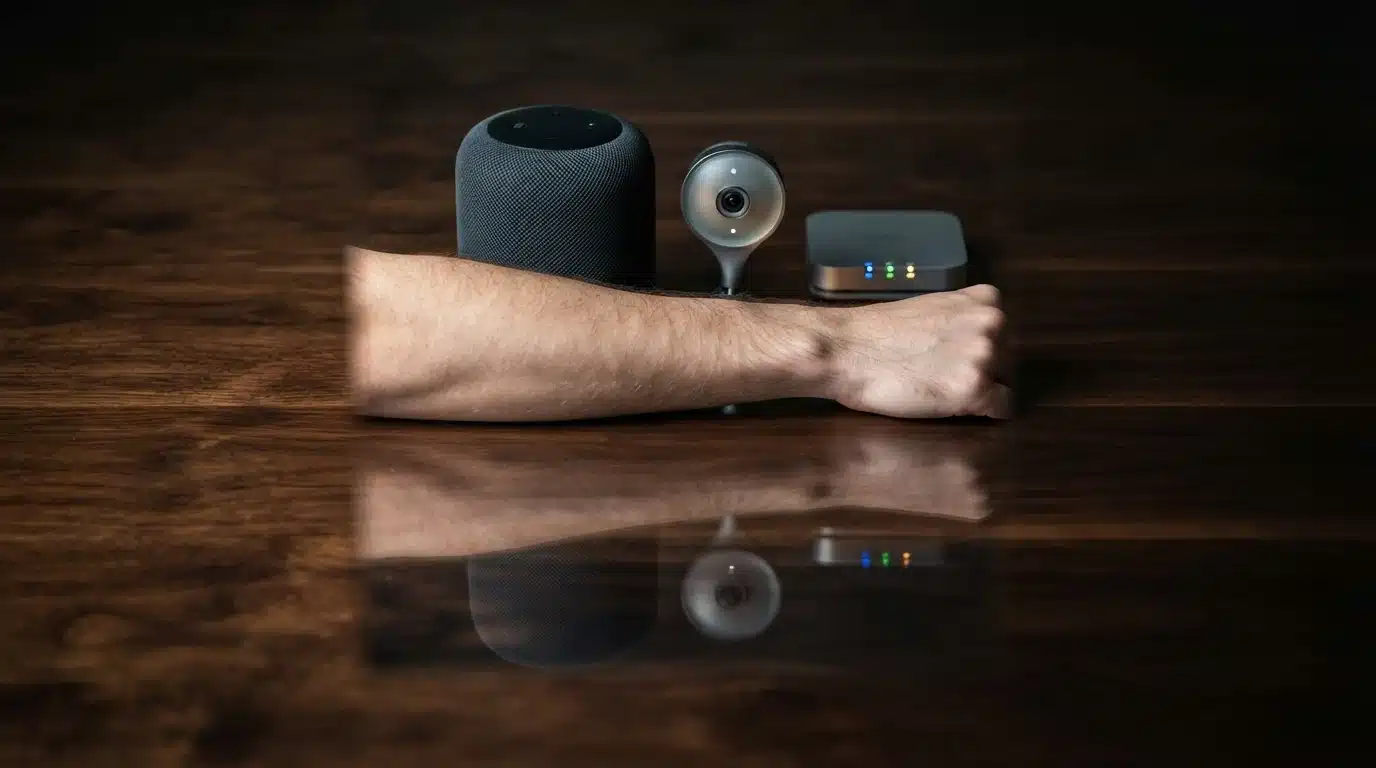
As artificial intelligence weaves itself almost invisibly into the fabric of our homes, the question is no longer whether our house will be smart, but how autonomous we’ll allow it to be. The current trajectory points to a future in which the home not only anticipates our needs but makes decisions on our behalf to optimize well-being and efficiency. This forces us to raise a fundamental question: if we delegate the small decisions of daily life, from the thermostat to the shopping list, are we freeing up mental space for more important matters, or are we gradually unlearning how to make our own decisions? The real challenge won’t be technological but philosophical: defining what role we want to keep playing in managing our own lives within walls that know us better every day.
Frequently Asked Questions About AI Smart Homes
What is an AI-powered smart home?
It’s an ecosystem of connected devices that doesn’t just react to commands but learns from your habits and routines to anticipate your needs. AI acts as the brain that proactively optimizes the home’s comfort, security, and energy efficiency.
How does AI improve security in my smart home?
AI improves security by analyzing images to distinguish between people, animals, and objects, reducing false alarms by more than 85%. It can also identify unusual patterns and suggest preventive actions, such as alerting you if a garage door has been left open while you’re away.
What should I consider about data privacy in my AI smart home?
It’s crucial to choose manufacturers with transparent privacy policies that let you control your data. Prioritize devices that process information locally, and always turn on two-factor authentication (MFA) to protect your accounts from unauthorized access.
What are the most popular AI smart devices right now?
The most common are voice assistants like Alexa or Google Assistant, smart thermostats that learn your temperature preferences, and security cameras with object recognition. Their true potential is unlocked when they are integrated to work together.
Is it hard to add AI to an existing smart home?
It’s getting easier all the time. Many modern devices already come with built-in AI capabilities. In addition, standards like Matter make communication between devices from different brands easier, allowing a central hub (such as Google Home or Apple HomeKit) to orchestrate smart automations.