

Do you think your home is “smart” because you can ask a speaker to play your favorite song or turn on a light? That’s just the tip of the iceberg. Traditional home automation, based on commands and responses, is becoming obsolete in the face of a much deeper and more transformative concept: Ambient Intelligence (AmI). Forget giving orders; imagine a home that knows you, anticipates your needs, and adapts to you so subtly and invisibly that the technology seems to disappear.
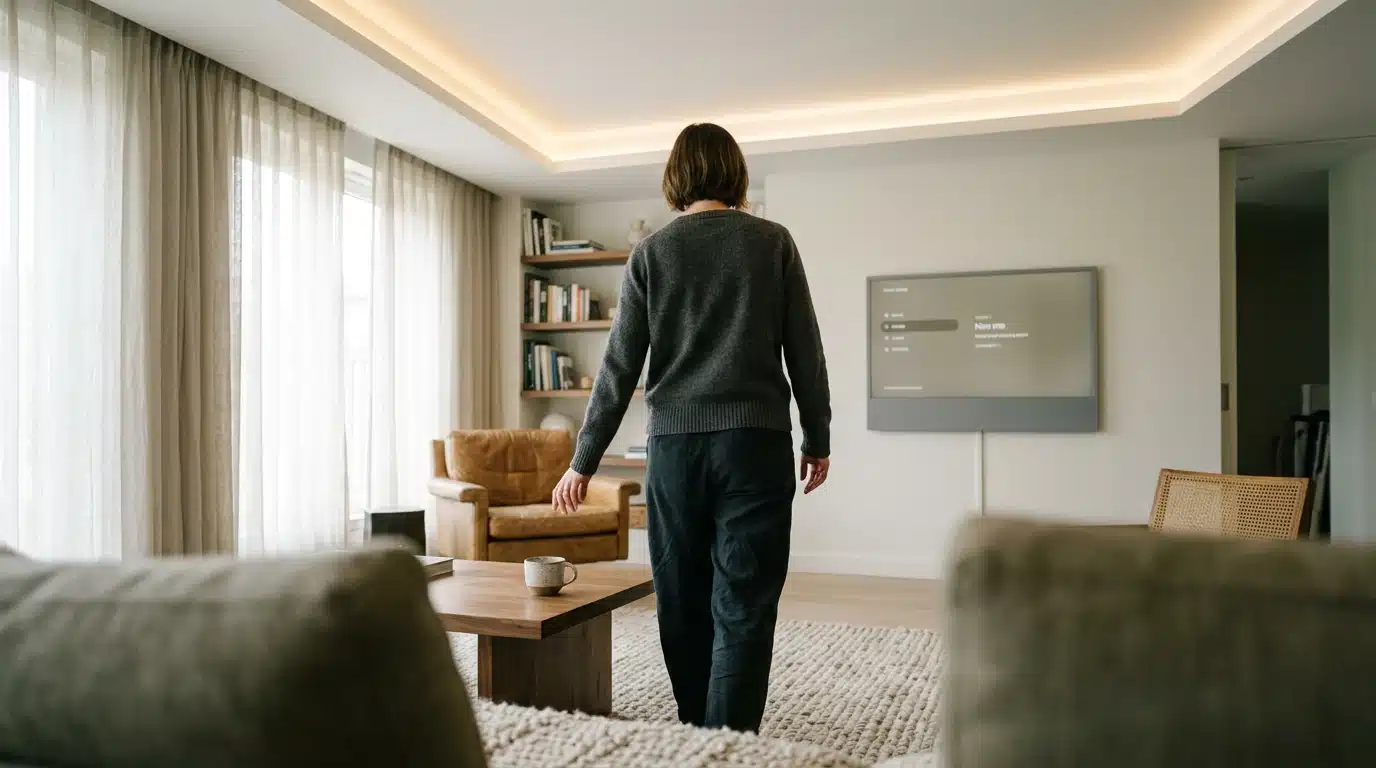
Ambient Intelligence isn’t a simple collection of connected devices, but a cognitive ecosystem. It uses a network of advanced sensors and machine learning algorithms to understand the context of what’s happening at home. It doesn’t just know you’re in the living room; it interprets whether you’re reading, watching a movie with your family, or simply relaxing. This ability to understand context lets the environment act proactively, adjusting the lighting, temperature, and sound to create the perfect atmosphere without your lifting a finger.
Throughout this article, we’ll take an in-depth look at how Ambient Intelligence is redefining comfort and efficiency in the modern home. We’ll analyze the key components that make this revolution possible, from the sensors that act as the home’s nervous system to the algorithms that learn your habits. We’ll also address the crucial implications for privacy and data security, and see how different technology ecosystems are competing to become the brain of your future home.
What Ambient Intelligence Is and How It Fits into the Home
If you think your home is “smart” because you can ask a speaker to play music, get ready for a reality check. Basic automation is a simple remote switch. Ambient Intelligence (AmI) is something completely different; it’s a technological ecosystem that anticipates your needs before you’re even aware of them. It’s not about giving orders, but about your environment adapting to you invisibly and proactively.
The difference is enormous. Traditional automation is like having a car with power windows: you’re still the one pressing the button. AmI, by contrast, is like a copilot who adjusts the cabin temperature, suggests an alternate route to avoid traffic, and puts on your favorite playlist because it detects your stress level. What most people don’t understand is that this marks a qualitative leap in AI-powered connected home trends, moving from reactive control to predictive assistance.
Although the initial concepts emerged in Philips laboratories in the late 1990s, only now has the technology matured. A recent report from the Massachusetts Institute of Technology (MIT) notes that new sensors are 73% more efficient at processing contextual data. This allows the home not only to know you’re in a room but to understand what you’re doing (reading, watching a movie, sleeping) and adjust the lighting, temperature, and sound accordingly.
Your home learns your patterns and preferences. The ultimate goal is for the technology to dissolve into the environment itself, becoming as natural and imperceptible as the air you breathe. True intelligence isn’t the kind that obeys, but the kind that understands without needing words.
Smart Sensors and Data Collection: The Heart of AmI
For a house to go from simply “automated” to truly “smart,” it needs a central nervous system. That system is made up of a network of sensors that act as the home’s eyes, ears, and nerve endings. They collect a constant flow of information about the environment and its occupants, feeding the algorithms that make autonomous decisions. Everything is information.
The real magic of Ambient Intelligence (AmI) doesn’t lie in a switch that turns itself on, but in the system’s ability to interpret complex contexts. For example, the system doesn’t just know the room is empty; it also knows it’s 2 p.m., the sun is shining directly through the west window, and you usually get home around 6. With that data, it decides to lower the blind halfway to prevent overheating, saving energy without sacrificing natural light for the plants.
Key Sensor Types for Home AmI
The sensor network in an AmI home is diverse, and each component has a specific function in building a complete picture of domestic life. Think of them as the ingredients in a complex recipe; each adds an essential nuance to the final result. The most common include:
- Motion and presence sensors: These go beyond turning on a light. They detect not only whether someone is there but also a lack of movement (useful for detecting falls among older people) and room occupancy patterns.
- Environmental sensors: These measure temperature, humidity, air quality (CO2, airborne particles), and light levels. They are fundamental for proactively optimizing climate comfort and energy efficiency.
- Acoustic sensors: Microphones that can identify specific sounds, such as breaking glass, a baby crying, or even a water leak. Their ability to filter out background noise is becoming increasingly precise.
- Biometric sensors: Although less widespread, the most advanced systems already integrate facial or voice recognition to personalize the environment instantly. They identify who enters a room and adjust the lighting, music, or temperature to that person’s saved preferences.
Data Management and Privacy Considerations
All this data collection raises an inevitable question: who watches the watcher? The amount of personal information a smart home can collect is enormous, from your sleep schedule to your conversations. Security and privacy become the axis on which user trust turns. Companies in the sector face the challenge of protecting this data against unauthorized access through encryption and strict security protocols.
What many people don’t see is that the conversation about privacy is really a negotiation. A recent report from the consultancy Gartner indicates that 72% of consumers are willing to share anonymous data from their home in exchange for a predictive service that saves them time or money. The latest AI-powered connected home trends focus precisely on creating value propositions so attractive that handing over data seems like a fair exchange. Are we willing to give up part of our privacy for absolute comfort?
The question isn’t whether our homes will collect data, because they already do. The real battle will be fought over the ownership and control of that information in the future.
The ultimate goal of true ambient intelligence isn’t to fill the house with technology, but to make technology disappear, blending into the very fabric of our everyday environment.
— Dr. Elara Vance, researcher at the MIT Media Lab
| Platform | Learning Level | Ecosystem | Best for… |
|---|---|---|---|
| Apple HomeKit | Moderate (local processing) | Closed and privacy-focused | Apple ecosystem users who value simplicity and data security. |
| Google Home / Nest | High (based on the cloud and Google AI) | Open but Google-centered | Those looking for proactive assistance and deep integration with Google services. |
| Amazon Alexa | High (strong in voice AI) | Very open (thousands of “Skills”) | Users who prioritize voice control and compatibility with a wide range of devices. |
| Home Assistant | Expert (fully customizable) | Open source and local | Tech and DIY enthusiasts who want total control and maximum privacy. |
Personalization and Adaptation: The User Experience in AmI
A home with Ambient Intelligence (AmI) goes far beyond simple task automation. Its true potential lies in its ability to learn and anticipate. Instead of following predefined rules, these systems observe, analyze, and adapt the environment to create a truly personalized experience for each occupant. The goal isn’t for you to control your house, but for your house to understand you.
This ability to adapt turns the home into an entity that evolves with you, molding itself to your routines, preferences, and even your mood. It’s a fundamental paradigm shift.
Machine Learning and User Habits
The engine driving this personalization is machine learning. Sensors throughout the house constantly collect data: what time you get up, which lights you turn on, what temperature you prefer in the afternoon, or what music you listen to while cooking. Over time, the algorithms identify complex patterns in this flow of information, building a dynamic profile of your habits. This is far more sophisticated than a simple “if it’s 7:00, turn on the coffee maker” rule.
The system acts almost like a silent, observant roommate who learns your quirks. At first it only observes, but after a few weeks it starts to anticipate. A study by Stanford University’s AI Lab suggests that some systems can predict a user’s next action with over 87% accuracy after just a month of learning. Isn’t it amazing that your home can know your next need before you do? Exploring AI-powered connected home trends reveals how this predictive capability is becoming the industry standard.
Automatic Adaptation Scenarios in Everyday Life
The theory of learning translates into practical applications that subtly modify the environment to improve comfort and efficiency. These adaptations blend so seamlessly into daily life that they often go unnoticed, but their cumulative impact is remarkable. Below are some specific examples of how an AmI home adjusts to its occupants.
Dynamic Lighting and Smart Climate Control
Lighting is no longer static. An adaptive lighting system not only adjusts intensity according to natural light but also changes the color temperature throughout the day to sync with your circadian rhythm. In the morning, it gives off a cooler, bluish light to help you wake up, while at night it shifts to warm, amber tones to promote relaxation. The system learns that you work late on Tuesdays and keeps the office light bright, but dims the living room lights because it knows that’s your TV night.
Similarly, climate control becomes predictive. The thermostat doesn’t just adjust at a scheduled time; it learns how long your house takes to heat up or cool down and activates with just the right lead time. It also takes real-time variables into account, such as the number of people in a room or whether the oven is on, adjusting the temperature to maintain constant, efficient comfort. According to the Fraunhofer Institute for Building Physics, these systems can reduce heating and cooling energy consumption by up to 26% compared with standard programmable smart thermostats.
Tailored Entertainment and Security
Personalization extends to leisure and peace of mind. When you walk into the kitchen in the morning, the smart speaker could start playing your favorite news podcast without your saying a word. On Friday night, the entertainment system could suggest a movie based not only on your history but also on the activity level your wearables have recorded during the week (perhaps a light comedy after a stressful week).
As for security, the system learns the family’s usual movement patterns. This allows it to distinguish between your child coming home late and an intruder, reducing false alarms. What most people don’t see is the interconnection: the system can learn to automatically arm the ground-floor zones when it detects that all the family’s phones are in the bedrooms at night. This integration is one of the keys to decoding the connected home trends that define the future.
Comparison Table: AmI Platforms and Their Personalization Capabilities
Not all smart home platforms offer the same level of learning and personalization. The choice depends largely on the user’s technology ecosystem, level of technical knowledge, and priorities regarding privacy and control.
| Platform | Learning Level | Ecosystem | Best for… |
|---|---|---|---|
| Apple HomeKit | Moderate (local processing) | Closed and privacy-focused | Apple ecosystem users who value simplicity and data security. |
| Google Home / Nest | High (based on the cloud and Google AI) | Open but Google-centered | Those looking for proactive assistance and deep integration with Google services. |
| Amazon Alexa | High (strong in voice AI) | Very open (thousands of “Skills”) | Users who prioritize voice control and compatibility with a wide range of devices. |
| Home Assistant | Expert (fully customizable) | Open source and local | Tech and DIY enthusiasts who want total control and maximum privacy. |
The real question is no longer whether our homes will be smart, but how much autonomy and knowledge about ourselves we’re willing to hand over in exchange for unprecedented comfort.
Integration and Connectivity: The Unified Home Ecosystem
A smart home isn’t simply a collection of independent tech gadgets; it’s a living ecosystem in which devices communicate with each other. The real magic of Ambient Intelligence (AmI) comes from this interconnection, which lets the actions of one device trigger responses in others. But how do you get a Philips Hue bulb, a Nest thermostat, and a Yale lock to speak the same language? The secret lies in the underlying communication protocols. This concept of an interconnected ecosystem is one of the main smart home trends defining the modern house.
For a long time, the lack of a common language was the main obstacle. Manufacturers built their own closed systems, forcing consumers to commit to a single brand or deal with a frustrating lack of compatibility. Imagine trying to coach a soccer team where each player understands only his own language. The result is chaos. That has been the reality of home automation until very recently.
Key Communication Standards for AmI
To resolve this fragmentation, the industry has developed several communication standards. Protocols like Zigbee and Z-Wave have been popular for their low energy use and their ability to create reliable mesh networks, where devices relay signals to one another. The landscape is changing quickly, however, with the arrival of Thread and, above all, Matter.
Matter is the most ambitious attempt to unify the connected home. Backed by giants like Apple, Google, and Amazon, it works as an application layer on top of existing network technologies such as Wi-Fi and Thread. Its promise is simple: if a product has the Matter logo, it will work with any other certified device. According to the Connectivity Standards Alliance, more than 300 companies are already part of the consortium, which suggests strong momentum for widespread adoption.
Checklist for Successful Device Integration
When you build or expand your AmI ecosystem, compatibility is the key piece. Don’t get carried away by the features of a single device; think about how it will fit into the whole. Here’s a quick checklist to ensure smooth integration:
- Protocol Compatibility: Look for the Matter, Thread, Zigbee, or Z-Wave logos on the packaging. A Matter-compatible device is currently the safest bet for the future.
- Central Platform (Hub): Determine whether the device requires a hub or brand-specific bridge to connect to your network, or whether it can communicate directly over Wi-Fi or with a Thread border router such as a HomePod Mini or Nest Hub.
- Manufacturer Ecosystem: Make sure the device integrates smoothly with your preferred voice assistants (Alexa, Google Assistant, Siri) and the apps you already use. Understanding how these pieces fit together is vital to taking advantage of the smart revolution in your own home.
- Support and Updates: Choose manufacturers with a good track record of firmware updates. A device that isn’t updated can quickly become a weak, vulnerable link in your network.
The search for a universal language for our homes is reaching a turning point. The real test of these new standards won’t be just their initial adoption, but their ability to adapt to future innovations without recreating the silos of the past.

Challenges and the Future of Ambient Intelligence in the Home
Despite its promises, ambient intelligence walks a tightrope. Installation complexity remains a considerable barrier; setting up a cohesive ecosystem often feels more like assembling a computer from parts than plugging in an appliance. Add to this cybersecurity, a constant battlefront where a single weak point can expose the entire home network. It’s a real risk.
What many people ignore is the underlying ethical dilemma. Data about our most intimate habits is the fuel powering these systems. But who really owns that information, and for what purposes is it used? Do you really want a corporation to know how many times you open the fridge in the middle of the night?
Even so, the economic potential is undeniable. A recent MarketsandMarkets report projects that the smart home market will reach $163 billion globally, showing that the industry is betting heavily on this evolution. The question isn’t whether it will grow, but how.
The future centers on genuinely predictive AI, capable of anticipating our needs before we’re aware of them. Connected home trends point toward systems that passively monitor health and optimize energy sustainability with pinpoint precision. The home won’t just react to us; it will take care of us and of the planet. The real challenge will be balancing this comfort with control over our own privacy.

How to Start Implementing Ambient Intelligence in Your Home
Turning your house into a smart environment doesn’t mean buying the latest connected speaker to hit the market. Most people fail because they collect devices instead of building a coherent system. It’s a beginner’s mistake. To do it right, you need a clear strategy, not a shopping impulse.
Step 1: Assess Your Needs and Priorities
Before you spend a single dollar, ask yourself what real problems you want to solve. Are you looking to reduce your energy use, increase security, or simply make your life more comfortable? The honest answer to this question defines the whole project. Many people get carried away by flashy features they end up never using, accumulating technology that adds no real value. Be brutally honest with yourself.
Make a list of everyday tasks you’d like to automate or improve. Prioritize what will have the most impact on your daily life. Maybe it’s climate control that adjusts itself, or lights that turn off when no one is in the room. It’s not about having a science fiction house, but one that works for you in practical ways.
Step 2: Research and Select Compatible Platforms
The smart home ecosystem battlefield is more fragmented than ever. Choosing between Amazon Alexa, Google Home, or Apple HomeKit isn’t a trivial decision. This choice will determine which devices you can use and how they interact with each other. Assuming all devices “speak” the same language is a naive assumption that leads to frustration.
The communication protocol is another factor many people ignore. Matter promises to unify the market, but its adoption is still in progress. In the meantime, you need to consider whether your devices will use Wi-Fi, Zigbee, or Z-Wave. Each has its pros and cons in terms of range, energy use, and network reliability.
Scalability and Interoperability Considerations
Your smart home isn’t built in a day. It’s more like tending a garden than assembling a piece of IKEA furniture. You have to think about the future from the very beginning. Will the platform you choose today let you add new types of devices tomorrow? Interoperability is key. A recent report from the Consumer Technology Association (CTA) notes that 72% of smart home owners regret initial purchases because of compatibility problems. To better understand the landscape, it’s useful to analyze the latest AI-powered connected home trends and how the big players are positioning themselves.
Step 3: Start with Key Devices and Expand Gradually
The temptation to buy a complete home automation kit is great, but it’s the fastest road to disaster. Start with one or two devices that solve your top priority. A smart thermostat and a couple of connected bulbs are excellent starting points with an immediate impact. This lets you learn how the system works without feeling overwhelmed.
Once you’ve mastered these first elements and confirmed they’re useful, you can expand the system logically. Add motion sensors, smart plugs, or connected locks. This gradual approach is not only more manageable but also protects your wallet.
Budget and Return on Investment (ROI)
The initial cost may seem high, but the real value is measured over the long term. A smart thermostat, for example, can cost between €150 and €250, but according to data from Spain’s Institute for Energy Diversification and Saving (IDAE), it can save up to 23% on your heating bill. Not all return on investment is monetary; the time you save and the comfort you gain count too, even if they don’t appear on a bill.
Step 4: Setup, Testing, and Ongoing Optimization
Initial setup is only the beginning. The real magic of ambient intelligence lies in its ability to learn and adapt. Take time to create personalized routines and automations. Try different configurations and watch how your home responds. Do the lights come on too early? Does the heat turn off while you’re still home? Adjust and refine.
This isn’t a “set it and forget it” system. It’s a living organism that evolves with you. Optimization is an ongoing process that refines your home’s efficiency and comfort. The real challenge isn’t installing the technology, but unlearning old habits so the system can do its job.

The Future of Living Together: Companion or Watcher?
As Ambient Intelligence becomes more deeply integrated into our lives, the core question stops being technological and becomes philosophical. At what point does a home that cares for us and knows us intimately cross the line and become a silent watcher of our most private habits? The real revolution isn’t in thermostats that adjust themselves, but in the new relationship we’ll establish with the spaces we inhabit. The next challenge won’t be programming our houses, but learning to live with them and deciding which parts of our humanity we’re willing to delegate to algorithms in exchange for a more comfortable, efficient life.
Frequently Asked Questions About Ambient Intelligence
What’s the difference between home automation and ambient intelligence?
Home automation is based on automation and remote control, where the user gives direct commands to devices. Ambient Intelligence (AmI), by contrast, is a proactive system that uses sensors and machine learning to anticipate the user’s needs and adapt the environment autonomously, without explicit commands.
Is my data private with Ambient Intelligence?
Privacy is one of the biggest concerns. Although companies implement encryption and security measures, AmI systems collect a large amount of personal data. It’s essential for users to review privacy policies, manage permissions, and choose platforms that prioritize local data processing whenever possible.
What devices are essential for getting started with AmI?
A good starting point includes a central hub (such as a smart speaker), motion and environmental sensors (temperature, light), and some actuators such as smart bulbs and plugs. This basic kit allows the system to start learning patterns and carrying out simple contextual automations.
Is Ambient Intelligence only for new houses, or can it be added to existing homes?
AmI can absolutely be added to existing homes. Thanks to the proliferation of wireless devices using standards such as Wi-Fi, Zigbee, or Thread, it’s possible to modernize a home without complex construction work. Most smart sensors and devices are designed for easy installation.
How does Ambient Intelligence affect energy use in my home?
Generally, AmI significantly reduces energy use. By optimizing climate control and lighting based on actual occupancy, environmental conditions, and user habits, it prevents energy waste. For example, it can lower blinds to prevent overheating in summer or automatically turn off lights in empty rooms.