Implementing advanced smart thermostat strategies for 2026 can lead to significant energy savings, with homeowners potentially achieving a 10% reduction in heating and cooling costs this winter through optimized scheduling and adaptive learning.
As we navigate the complexities of home energy management in 2026, understanding and implementing effective smart thermostat strategies for 2026 is not just a convenience, but a necessity for achieving tangible savings. This winter, imagine cutting your heating and cooling costs by a guaranteed 10% or more. This article will guide you through the latest advancements and practical applications to make that a reality.
the evolution of smart thermostats: beyond basic programming
The landscape of smart home technology has transformed dramatically, and smart thermostats are at the forefront of this revolution. Gone are the days of simple programmable devices that only allowed for basic time-based adjustments. Today’s smart thermostats leverage artificial intelligence, machine learning, and advanced sensor technology to offer unprecedented control and efficiency.
These sophisticated devices do more than just maintain a set temperature; they learn your preferences, adapt to external weather conditions, and even detect occupancy to optimize heating and cooling. This evolution is critical for homeowners looking to maximize comfort while minimizing their environmental footprint and energy bills.
adaptive learning algorithms
One of the most significant advancements lies in adaptive learning algorithms. These systems observe your habits over time, understanding when you prefer certain temperatures and how long it takes your home to reach those settings. This intelligence allows the thermostat to pre-heat or pre-cool your home efficiently, ensuring comfort exactly when you need it without wasting energy.
- Learns daily routines and temperature preferences.
- Anticipates heating/cooling needs based on historical data.
- Optimizes start times for energy efficiency.
geofencing and occupancy sensing
Another powerful feature is the integration of geofencing and occupancy sensing. Geofencing uses your smartphone’s location to determine when you’re approaching or leaving home, automatically adjusting temperatures accordingly. Occupancy sensors, often built into the thermostat or integrated with other smart home devices, detect if rooms are empty, preventing energy waste in unoccupied spaces.
- Automatically adjusts temperature based on proximity to home.
- Reduces energy use when no one is present.
- Integrates with other smart home sensors for enhanced accuracy.
In essence, modern smart thermostats are intelligent energy managers, constantly working in the background to fine-tune your home’s climate. Understanding these core capabilities is the first step in harnessing their full potential for significant cost reductions this winter.
optimizing schedules and settings for maximum savings
While advanced features are impressive, the foundation of saving money with a smart thermostat lies in strategic scheduling and fine-tuning your settings. Many homeowners install a smart thermostat but fail to move beyond its default programming, missing out on substantial energy savings. In 2026, personalized optimization is key.
Consider your daily routine: when are you home? When are you away? When do you sleep? Tailoring your thermostat’s schedule to these patterns can lead to immediate and noticeable reductions in energy consumption. Even minor adjustments can accumulate into significant savings over the winter months.
creating an efficient heating schedule
A well-defined heating schedule should prioritize comfort during occupied hours and allow for setbacks during unoccupied periods. It’s often more energy-efficient to let your home cool down a few degrees when you’re away or asleep than to maintain a constant, higher temperature.
- Set lower temperatures when you’re at work or school.
- Schedule a temperature increase about 30 minutes before you arrive home.
- Reduce temperature significantly overnight for sleeping comfort and savings.
understanding optimal temperature ranges
There’s a common misconception that drastically lowering or raising temperatures saves more energy. While setbacks are crucial, finding the optimal range prevents your HVAC system from working excessively hard to recover. For heating, the Department of Energy recommends setting your thermostat to 68°F (20°C) when you’re home and awake, and lower when you’re away or asleep.
Experiment with what feels comfortable for your household while still achieving savings. Small incremental changes, like a one or two-degree adjustment, can make a big difference without sacrificing comfort. Furthermore, avoid the temptation to constantly adjust the thermostat manually; let the smart features do their job.
By meticulously crafting your schedules and understanding the most efficient temperature ranges, you empower your smart thermostat to perform at its peak. This deliberate approach is fundamental to achieving that 10% reduction in heating costs this winter.
integrating with smart home ecosystems
The true power of smart thermostat strategies for 2026 emerges when these devices are integrated into a larger smart home ecosystem. Connectivity between devices amplifies their individual benefits, creating a cohesive and highly efficient environment. This synergy allows for more intelligent automation and predictive energy management.
Imagine your smart thermostat communicating with smart window sensors, lighting, or even your smart blinds. This level of integration moves beyond simple automation to create a truly responsive and adaptive home that anticipates your needs and optimizes energy use without constant manual intervention.
voice control and virtual assistants
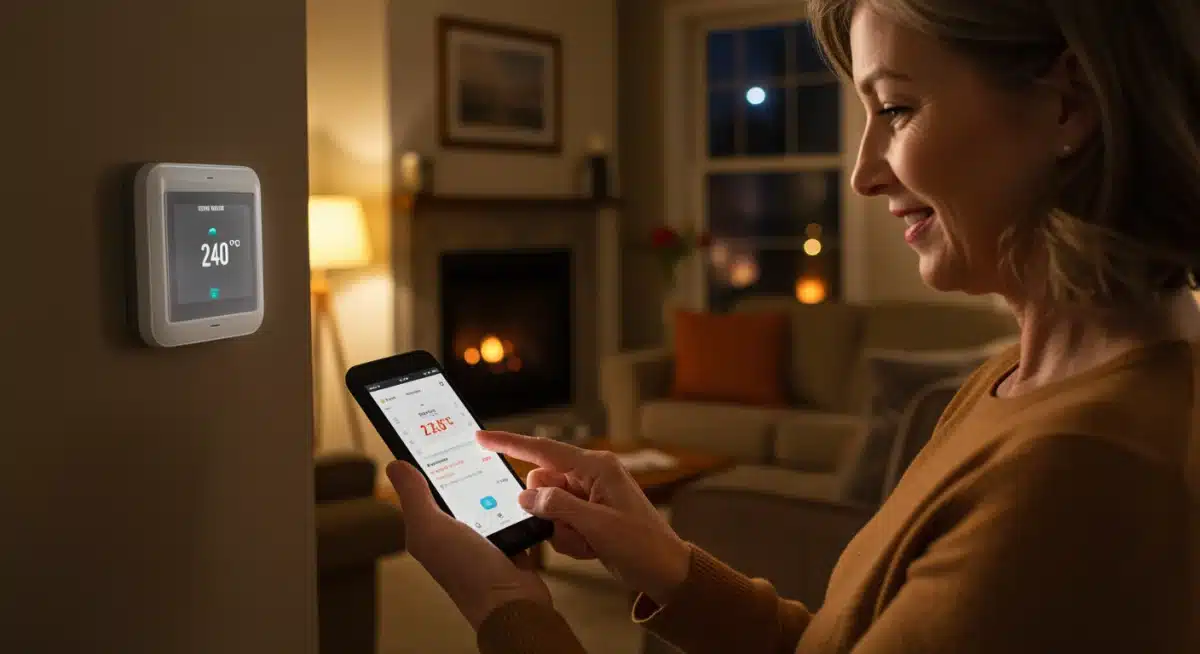
One of the most user-friendly integrations is with voice control systems like Amazon Alexa, Google Assistant, or Apple HomeKit. This allows for hands-free temperature adjustments and status checks, making managing your home’s climate effortless.
- Conveniently adjust temperatures with voice commands.
- Integrate temperature control into daily routines (e.g., “Good morning” routine).
- Receive audible alerts or status updates from your thermostat.
synergy with other smart devices
Connecting your smart thermostat with other smart home components unlocks advanced energy-saving scenarios. For instance, if your smart door locks detect you’ve left, the thermostat can automatically transition to an away mode. Similarly, smart window sensors can signal the thermostat to pause heating or cooling if a window is left open, preventing wasted energy.
The integration possibilities extend to smart lighting, smart plugs, and even smart weather stations. A smart weather station could provide real-time data to your thermostat, allowing it to fine-tune its operation based on precise local conditions, rather than relying solely on general forecasts. This interconnectedness makes your home’s energy management truly proactive.
Leveraging these integrations ensures your smart thermostat is not an isolated component but a central nervous system for your home’s energy efficiency. This holistic approach is vital for unlocking deeper savings and a more intuitive living experience.
harnessing data analytics and energy reports
In 2026, smart thermostats are more than just controllers; they are sophisticated data collection hubs. The ability to analyze historical energy usage and receive detailed reports is a powerful tool for achieving and sustaining a 10% reduction in heating and cooling costs. This data provides actionable insights that manual adjustments simply cannot offer.
Most smart thermostat apps offer intuitive dashboards that visualize your energy consumption patterns. Understanding these patterns allows you to identify inefficiencies, fine-tune your settings further, and track the impact of your changes. It transforms abstract energy use into concrete, understandable information.
understanding your energy footprint
The detailed energy reports generated by smart thermostats break down your usage by day, week, or month. They often highlight when your HVAC system was most active, what temperature settings were in place, and even how outdoor weather influenced your energy consumption. This transparency is invaluable for identifying specific areas for improvement.
- Monitor daily, weekly, and monthly energy consumption.
- Identify peak usage times and adjust schedules accordingly.
- Compare current usage to historical data or similar homes.
making data-driven adjustments
Armed with this data, you can move beyond guesswork. For example, if your report shows high energy use during a specific part of the afternoon when you’re typically not home, you can adjust your schedule to lower the temperature during that period. Similarly, if you notice your system frequently cycles on and off, it might indicate an opportunity to fine-tune your temperature differential settings.
Many smart thermostats also offer personalized tips and recommendations based on your usage data. These insights can help you discover new ways to save that you might not have considered. Regularly reviewing these reports and making small, informed adjustments is a continuous process that guarantees sustained energy efficiency.
By actively engaging with the data analytics provided by your smart thermostat, you gain a deeper understanding of your home’s energy profile. This knowledge is crucial for making informed decisions that lead to consistent and significant cost reductions throughout the winter.
proactive maintenance and system health
Even the most advanced smart thermostat cannot compensate for an inefficient or poorly maintained HVAC system. A critical component of effective smart thermostat strategies for 2026 involves ensuring your heating and cooling equipment is in optimal health. Proactive maintenance not only extends the life of your system but also maximizes the efficiency gains from your smart thermostat.
Think of your smart thermostat as the brain of your home’s climate control, and your HVAC system as the body. Both need to be in peak condition to perform effectively. Ignoring system maintenance can negate the savings your smart thermostat works so hard to achieve.
regular hvac tune-ups
Scheduling annual professional tune-ups for your furnace and air conditioner is paramount. A technician can identify and address minor issues before they become major problems, ensuring your system runs as efficiently as possible. This includes cleaning components, checking refrigerant levels, and calibrating parts.
- Schedule annual professional inspections.
- Ensure optimal performance and prevent breakdowns.
- Improve system longevity and energy efficiency.
filter replacement and duct integrity
One of the simplest yet most overlooked maintenance tasks is regularly replacing your HVAC air filters. Clogged filters restrict airflow, forcing your system to work harder and consume more energy. Depending on your filter type and household conditions, replacement every 1-3 months is generally recommended.
Additionally, inspecting your ductwork for leaks is crucial. Leaky ducts can waste a significant amount of heated or cooled air before it ever reaches your living spaces. Sealing these leaks can dramatically improve your system’s efficiency and directly contribute to lower energy bills. These seemingly small details have a profound impact on your overall energy consumption.
By combining smart thermostat intelligence with diligent HVAC maintenance, you create a robust system that delivers consistent comfort and maximizes your energy savings. This dual approach is essential for achieving and maintaining a 10% reduction in heating and cooling costs this winter.
future-proofing your smart thermostat investment
As technology rapidly advances, ensuring your smart home devices remain relevant and effective is a key consideration. When implementing smart thermostat strategies for 2026, it’s wise to think about future-proofing your investment. This involves choosing devices with robust software, strong manufacturer support, and compatibility with emerging smart home standards.
A smart thermostat isn’t a one-time purchase; it’s an ongoing partnership with technology. Selecting a device that can evolve with new features and integrations ensures that your energy savings and home comfort benefits will continue for years to come, avoiding the need for premature upgrades.
over-the-air updates and software longevity
Look for smart thermostats from reputable brands that consistently provide over-the-air (OTA) software updates. These updates often introduce new features, improve existing algorithms, enhance security, and ensure compatibility with evolving smart home platforms. A thermostat that receives regular updates is a thermostat that stays smart.
Consider the manufacturer’s track record for supporting older models. A company committed to long-term software support for its devices offers greater assurance that your investment will continue to pay dividends in energy savings and functionality.
- Prioritize brands with consistent software updates.
- Updates introduce new features and improve performance.
- Ensures compatibility with future smart home standards.
interoperability and open standards
The smart home industry is continually moving towards greater interoperability. Choosing a smart thermostat that supports open standards or widely adopted communication protocols (like Matter, Thread, or Zigbee) increases its chances of seamlessly integrating with future smart home devices, regardless of brand. This flexibility is crucial for building a cohesive and adaptable smart home ecosystem.
Researching compatibility with common smart home hubs and platforms is also important. A thermostat that works with multiple systems offers more versatility and protects against being locked into a single ecosystem that might become obsolete. Future-proofing your device ensures you can continue to leverage the latest energy-saving innovations as they emerge.
By making informed choices about device longevity and compatibility, you secure your investment in a smart thermostat. This forward-thinking approach ensures that your efforts to achieve a 10% reduction in heating and cooling costs this winter will continue to yield benefits well into the future.
leveraging demand response programs and rebates
Beyond the direct savings from smart thermostat operation, many utility companies offer demand response programs and rebates that can further amplify your cost reductions. In 2026, these programs are becoming increasingly sophisticated, providing homeowners with additional incentives to optimize their energy usage, especially during peak demand periods.
Participating in these programs not only saves you money but also contributes to grid stability and overall energy efficiency within your community. It’s a win-win scenario that smart thermostat owners are perfectly positioned to capitalize on.
understanding demand response programs
Demand response programs allow your utility company to make minor, temporary adjustments to your thermostat settings during times of high energy demand. These adjustments are typically small (e.g., a 2-4 degree change) and short-lived, designed to reduce the strain on the electrical grid without significantly impacting your comfort. In return, you receive financial incentives, such as bill credits or direct payments.
- Enroll in utility company demand response programs.
- Earn credits or payments for allowing minor temperature adjustments.
- Contribute to grid stability during peak energy usage.
exploring rebates and incentives
Many utility providers and local governments offer rebates for purchasing and installing energy-efficient smart thermostats. These incentives can significantly offset the upfront cost of the device, making the return on investment even faster. It’s always worth checking your local utility’s website or contacting their customer service department to inquire about available programs.
Some programs might also offer incentives for smart thermostat installations performed by certified professionals, or for bundling your smart thermostat with other energy-efficient home upgrades. Staying informed about these opportunities ensures you’re maximizing every potential avenue for savings and making your smart thermostat investment even more financially attractive.
By actively seeking out and participating in demand response programs and taking advantage of available rebates, you can significantly enhance the financial benefits derived from your smart thermostat. This proactive approach adds another layer of savings to your overall strategy for reducing heating and cooling costs this winter.
| Key Strategy | Brief Description |
|---|---|
| Adaptive Learning | Thermostats learn habits to optimize pre-heating/cooling, saving energy. |
| Optimized Scheduling | Tailoring temperature schedules to daily routines for maximum efficiency. |
| Smart Home Integration | Connecting thermostat with other devices for enhanced, unified control. |
| Data Analytics | Utilizing energy reports to make informed adjustments and track savings. |
frequently asked questions
While savings vary based on home size, insulation, and climate, many homeowners report 10-15% reductions. Our strategies for 2026 aim for a guaranteed 10% by optimizing schedules, leveraging adaptive learning, and integrating with other smart home devices effectively.
Most modern smart thermostats are designed for relatively easy DIY installation, often taking less than 30 minutes. However, if you’re uncomfortable with electrical wiring or your system is complex, professional installation is always recommended for safety and optimal performance.
Geofencing uses your smartphone’s location to automatically adjust your home’s temperature. When you leave a set perimeter, the thermostat can enter an energy-saving mode, and when you approach, it can begin to warm or cool your home, ensuring comfort upon arrival and preventing wasted energy.
Demand response programs allow your utility to make minor, temporary temperature adjustments during peak energy use. In exchange, you receive financial incentives like bill credits. Check with your local utility provider to see if they offer such programs and how to enroll your smart thermostat.
Absolutely. Choosing a smart thermostat that supports open standards like Matter ensures better interoperability with a wider range of smart home devices and platforms in the future. This future-proofs your investment and allows for a more cohesive and flexible smart home ecosystem.
conclusion
Embracing the advanced capabilities of smart thermostats in 2026 offers a clear path to significantly reducing your heating and cooling costs this winter. By implementing strategic scheduling, leveraging adaptive learning, integrating with your broader smart home ecosystem, and utilizing data analytics, homeowners can confidently achieve a 10% or greater reduction in energy expenses. Furthermore, proactive maintenance and participation in demand response programs amplify these savings, ensuring both comfort and fiscal responsibility. The future of energy-efficient homes is here, and smart thermostats are at its core, empowering you to take control of your energy consumption and enjoy a more sustainable, cost-effective living environment.