Advanced Voice Assistant Routines: 7 Insider Tips for 2025
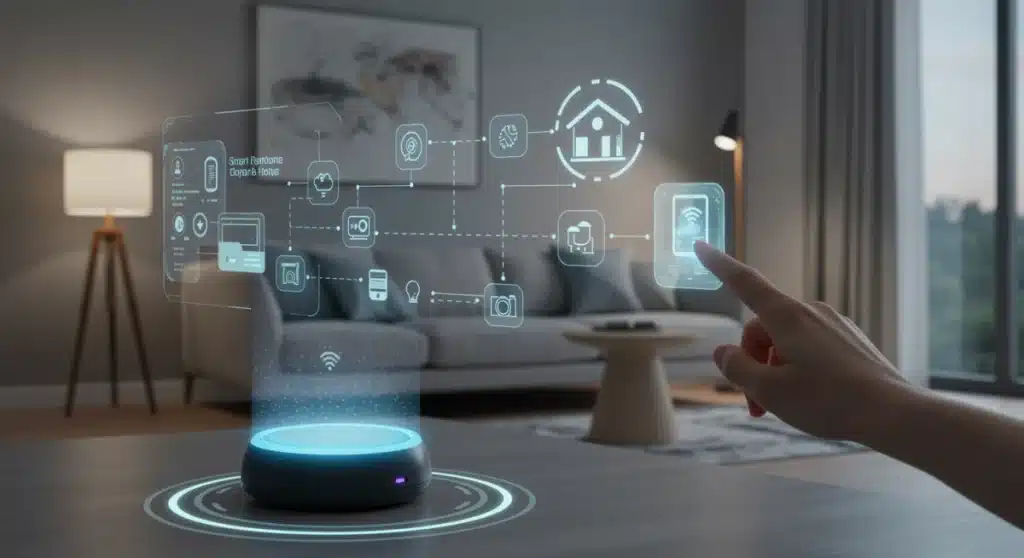
Mastering advanced voice assistant routines in 2025 transforms daily life, offering seamless automation and enhanced control over your smart home environment, moving beyond basic commands to truly intelligent interactions.
Are you ready to elevate your smart home experience beyond simple commands? In 2025, the true power of your voice assistant lies in its ability to execute advanced voice routines, turning your home into a truly intuitive and responsive environment. This guide will reveal insider tips and practical solutions to help you unlock unparalleled automation.
Leveraging context and personalization for smarter interactions
Voice assistants are no longer just command-and-response machines; they’ve evolved into intelligent companions capable of understanding context and personalizing interactions. In 2025, truly advanced routines begin with teaching your assistant to anticipate your needs based on time, location, and even your mood. This deep level of personalization moves beyond generic automation, creating a home environment that truly feels attuned to you.
Understanding context means your voice assistant can differentiate between “turn on the lights” when you’re entering the living room versus when you’re in the bedroom. Personalization takes this further, allowing for routines that adapt to individual preferences, such as different music choices or lighting scenes for various family members.
Implementing user profiles and voice recognition
Many modern voice assistants support multiple user profiles linked to voice recognition. This feature is fundamental for personalized routines.
- Create distinct profiles: Ensure each household member has their own profile.
- Train voice models: Spend time training the assistant to accurately recognize each voice.
- Assign preferences: Link specific music services, calendar accounts, and smart device settings to individual profiles.
By effectively utilizing user profiles, your voice assistant can trigger routines that are specific to who is speaking, enhancing both convenience and privacy. Imagine a morning routine that adjusts based on whose voice it recognizes, playing different news briefings or adjusting the thermostat to a preferred temperature.
In essence, moving towards context-aware and personalized voice routines transforms your smart home from a collection of devices into a truly intelligent ecosystem. This foundational step is crucial for building more sophisticated and responsive automation scenarios.
Integrating multi-device and cross-platform automation
The true power of advanced voice assistant routines in 2025 lies in their ability to seamlessly integrate across multiple devices and even different smart home platforms. Gone are the days of siloed ecosystems where your lights couldn’t talk to your thermostat because they were from different brands. Modern automation thrives on interoperability, creating a unified and highly functional smart home.
Achieving this level of integration often involves using a central hub or a robust automation platform that can bridge the communication gaps between various devices. This allows for complex routines where actions on one device can trigger responses on another, regardless of manufacturer.
Exploring Matter and Thread for universal compatibility
The advent of standards like Matter and Thread is revolutionizing cross-platform integration, promising a more unified smart home experience.
- Matter: A universal standard designed to enable smart home devices to work together seamlessly across different ecosystems.
- Thread: A low-power, mesh networking protocol that provides a robust and reliable connection between devices, often underpinning Matter.
- Benefits: Simplified setup, improved reliability, and broader device compatibility for your routines.
By focusing on Matter and Thread-compatible devices, you future-proof your smart home and ensure that your advanced routines can leverage the widest possible array of gadgets. This reduces complexity and expands the possibilities for intricate automation sequences.
Furthermore, consider platforms like Home Assistant or Hubitat for highly customized integrations. These open-source or advanced hubs offer unparalleled flexibility, allowing you to write custom scripts and connect devices that might not natively support each other. This level of control is essential for crafting truly unique and powerful routines that go beyond standard app functionalities.
Ultimately, a well-integrated multi-device and cross-platform setup is the backbone of any advanced voice assistant routine. It ensures that your commands can orchestrate a symphony of actions throughout your home, making your smart environment truly cohesive and responsive.
Utilizing conditional logic for dynamic routines
One of the most significant leaps in voice assistant automation for 2025 is the widespread availability and ease of implementing conditional logic. This means your routines aren’t just a linear sequence of actions but can adapt and change based on specific conditions. Instead of a fixed “good morning” routine, you can have one that checks the weather, your calendar, or even your sleep data before deciding what to do next.
Conditional logic introduces a layer of intelligence that makes your smart home truly dynamic. It allows routines to respond to the environment and your activities in a much more nuanced way, providing a personalized experience that feels almost predictive.
Applying “if-then-else” statements in routines
Most advanced voice assistant platforms now offer intuitive interfaces for building “if-then-else” logic into your routines.
- If (condition is met): For example, “If the temperature is below 68°F.”
- Then (perform action): “Then turn on the heater.”
- Else (perform alternative action): “Else, keep the fan off.”
This simple structure can be combined to create highly sophisticated routines. Consider a “leaving home” routine that not only locks doors and turns off lights but also checks if any windows are open and alerts you to close them, or if a specific appliance is still on. This level of proactive automation adds significant value and peace of mind.
Another powerful application of conditional logic is integrating external data sources. Imagine a routine that checks traffic conditions before suggesting your departure time, or one that adjusts your smart blinds based on the current sun position and cloud cover. These integrations move beyond simple device control, making your home a truly intelligent assistant.
Mastering conditional logic is key to moving beyond basic automation. It empowers you to create routines that are not only convenient but also genuinely smart, adapting to the ever-changing dynamics of your home and your life.
Incorporating external data sources and APIs
To truly unlock advanced voice routines in 2025, you must look beyond your immediate smart home devices and integrate external data sources and Application Programming Interfaces (APIs). This capability allows your voice assistant to pull information from the internet, weather services, public transit schedules, financial markets, and even your personal productivity apps. By doing so, your routines become infinitely more powerful and informed.
This integration transforms your voice assistant from a home controller into a comprehensive personal assistant, capable of making decisions and providing information based on a vast array of real-time data. The possibilities are expansive, limited only by the available APIs and your creativity.
Examples of external data integration
Integrating external data can dramatically enhance the utility of your voice assistant routines.
- Weather-based actions: Trigger sprinklers only if there’s no rain forecast.
- Calendar synchronization: Announce your next appointment and adjust lighting for a video call.
- Traffic updates: Get a summary of your commute before leaving, then adjust your smart thermostat to save energy once you’re gone.
- Stock market alerts: Receive a voice notification if a particular stock hits a certain price point.

Platforms like IFTTT (If This Then That) or Zapier can act as crucial intermediaries, connecting your voice assistant to hundreds of web services and external APIs. While some voice assistant platforms offer native integrations, these third-party services expand the reach significantly, allowing for highly customized and intricate data flows.
The ability to pull in real-time external data means your routines are no longer confined to the four walls of your house. They can react to the broader world, providing truly intelligent and valuable assistance. This is a cornerstone of next-level smart home automation.
Optimizing routine triggers and timing
A truly advanced voice assistant routine isn’t just about what it does, but also about when and how it’s triggered. Optimizing triggers and timing is crucial for creating a seamless and unobtrusive smart home experience. In 2025, we move beyond simple voice commands to a variety of sophisticated triggers, ensuring that automation happens precisely when it’s most useful, often without you even having to speak.
Effective timing can make the difference between a helpful routine and an annoying one. Carefully consider the duration, delays, and sequences within your routines to create a natural flow that enhances your daily life rather than disrupting it.
Exploring advanced trigger options
Beyond voice commands, a multitude of triggers can initiate your smart home routines.
- Geofencing: Routines activate when you enter or leave a specific area (e.g., turning on AC when you’re 5 minutes from home).
- Time-based and sunrise/sunset: Precisely timed actions or adjustments based on the natural light cycle.
- Sensor input: Motion sensors, door/window sensors, or even air quality sensors can trigger complex routines.
- Device status changes: A routine might start when a smart lock is engaged or disengaged, or when a smart appliance finishes its cycle.
Combining these triggers with conditional logic can create incredibly powerful and responsive automations. For instance, a “goodnight” routine could be triggered by a voice command, but only execute if all doors are locked and no motion is detected downstairs, ensuring security and peace of mind. Or, a morning routine could start 15 minutes before your first calendar event, but only if you’re already awake based on bed sensor data.
Fine-tuning the timing of actions within a routine is equally important. Instead of all lights turning on at once, a gentle, staggered illumination can create a more pleasant wake-up experience. Delays between actions can also prevent devices from overloading or ensure that one action completes before the next begins. This meticulous approach to triggers and timing elevates routines from functional to truly intuitive.
Implementing proactive and predictive automation
The pinnacle of advanced voice assistant routines in 2025 is the shift towards proactive and predictive automation. This is where your smart home no longer just reacts to your commands or simple triggers but anticipates your needs and acts accordingly, often before you even realize you have a need. This level of intelligence is powered by machine learning and continuous data analysis, making your home incredibly intuitive.
Proactive automation means your home is working for you in the background, making subtle adjustments and preparing for your next actions. Predictive automation takes this further, using patterns and external data to foresee future needs and act preemptively.
Leveraging AI for predictive behavior
Many voice assistant platforms are increasingly incorporating AI and machine learning to enable predictive capabilities.
- Learning patterns: Your assistant observes your habits over time (e.g., when you typically turn on certain lights).
- Anticipating needs: Based on learned patterns and external data, it might pre-heat your oven before you start cooking.
- Energy optimization: Predicting peak energy usage times to pre-cool or pre-heat your home to save costs.
- Health and wellness: Adjusting ambient lighting or soundscapes based on your sleep cycle or activity levels detected by wearables.
Imagine a routine that learns your typical bedtime and subtly dims the lights in your living room an hour beforehand, then gradually brightens them in your bedroom as you approach. Or, a routine that analyzes your commute patterns and traffic data to suggest leaving earlier on certain days, simultaneously adjusting your home’s climate control to an energy-saving mode. These are examples of true predictive intelligence.
Achieving proactive and predictive automation often requires a commitment to data collection and allowing your smart home system to learn from your interactions. While it might involve a higher initial setup or learning curve, the long-term benefits in comfort, efficiency, and convenience are substantial. This is the future of truly intelligent home automation.
Ensuring robust security and privacy in advanced setups
As voice assistant routines become more advanced and integrated, the importance of robust security and privacy measures escalates dramatically. In 2025, with more devices connected and more personal data being processed, safeguarding your smart home from vulnerabilities is paramount. An advanced setup is only truly effective if it’s also secure and respects your privacy.
Neglecting security can expose your personal data, grant unauthorized access to your home, or even compromise the functionality of your routines. Therefore, a proactive and informed approach to privacy and security is an integral part of building a sophisticated smart home.
Best practices for smart home security
Implementing a few key practices can significantly enhance the security and privacy of your advanced voice assistant routines.
- Strong, unique passwords: Use complex passwords for all smart devices and your Wi-Fi network.
- Two-factor authentication (2FA): Enable 2FA wherever available for an extra layer of security.
- Regular software updates: Keep all device firmware and app software up-to-date to patch vulnerabilities.
- Network segmentation: Consider setting up a separate Wi-Fi network for your IoT devices to isolate them from your main network.
- Review privacy settings: Regularly check and adjust the privacy settings of your voice assistant and associated apps.
Be mindful of the data your voice assistant collects and how it’s used. Most platforms offer options to review and delete voice recordings. Understand the terms of service for each smart device and service you integrate, paying attention to data sharing policies. Opt for devices from reputable manufacturers known for their commitment to security and regular updates.
Ultimately, a secure and private smart home is a foundation for peace of mind. By diligently managing your security settings and understanding data privacy, you can enjoy the full benefits of advanced voice assistant routines without compromising your digital safety or personal information.
| Key Aspect | Brief Description |
|---|---|
| Contextual Personalization | Routines adapt based on user, time, and environment for a tailored experience. |
| Cross-Platform Integration | Seamless device communication across different brands and ecosystems (e.g., Matter). |
| Conditional Logic | “If-then-else” statements enable dynamic routines that respond to various conditions. |
| Proactive Automation | AI-driven anticipation of needs, triggering actions before explicit commands. |
Frequently asked questions about advanced voice routines
Basic routines are simple, linear sequences of actions triggered by a single command. Advanced routines, however, incorporate conditional logic, external data, multi-device integration, and personalization, allowing them to adapt dynamically to various situations and user profiles for a much smarter, more responsive home automation experience.
To enhance context understanding, ensure your voice assistant has access to your location, calendar, and individual user profiles. Train voice recognition for each household member and configure device groups logically within your smart home app. This allows the assistant to differentiate commands based on who is speaking or where they are located.
Matter and Thread are crucial for universal compatibility. Matter is a standard that allows devices from different brands to communicate seamlessly, while Thread is a robust networking protocol. Together, they simplify setup, improve reliability, and enable more complex, cross-platform advanced routines, making your smart home ecosystem more cohesive and powerful.
Integrating external data can be safe if done cautiously. Always use strong passwords and two-factor authentication. Only connect reputable services and regularly review the privacy settings and data sharing policies of all integrated apps and devices. Keep all software updated to protect against potential vulnerabilities and maintain control over your personal information.
Proactive automation involves allowing your smart home system to learn your habits and patterns over time. Utilize features like geofencing, time-based triggers, and sensor inputs. Implement conditional logic to create routines that anticipate your needs based on external data like weather or traffic, enabling your home to act intelligently without explicit commands.
Conclusion
Mastering advanced voice assistant routines in 2025 transcends simple spoken commands, transforming your home into a truly intelligent and responsive environment. By embracing contextual personalization, cross-platform integration, dynamic conditional logic, and the power of external data, you can craft a smart home experience that genuinely anticipates your needs. Remember to prioritize robust security and privacy measures throughout your setup to ensure both convenience and peace of mind. The future of home automation is here, offering unparalleled levels of comfort, efficiency, and control, all at the sound of your voice.