
Every morning, the routine is the same: you stand in front of the mirror. But what if that reflection could tell you more than whether your hair looks right? Imagine that, in the few minutes you spend brushing your teeth, your mirror analyzed subtle changes in your skin, measured your heart rate without touching you, and alerted you to your stress levels. This future no longer belongs to science fiction; it’s arriving in homes and turning one of our most everyday objects into a powerful wellness assistant.
This evolution is part of the growing connected home trend, in which technology blends invisibly into our surroundings. Unlike a smartwatch or fitness band that we have to wear, a smart mirror works passively, collecting valuable data without requiring any action on our part. It’s the ultimate expression of ambient intelligence: getting important information about our health without adding another screen to our lives, by using a surface we already check every day.
The transition from a simple pane of glass to a personal health data center is fascinating and opens up new possibilities for proactive care. In this article, we’ll take an in-depth look at the key functions that make this possible, from skin analysis to vital sign monitoring. We’ll analyze how these devices concretely improve our daily lives, offer a guide for those who want to build their own system, and finally look at the innovations that will define the next generation of home health.
The Smart Mirror Revolution: Beyond the Reflection
Think about your bathroom mirror. For decades, its only job has been to show you your reflection. But what if it could do much more? Smart mirrors are turning this everyday object into a personal command center, a discreet assistant that gives you useful information while you brush your teeth. It’s a change similar to the one that turned phones into smartphones.
What many people don’t know is that this technology has gone from a project for DIY enthusiasts to a pillar of the connected home. It’s no longer just about showing the time and weather. Now, these devices integrate with your calendar, play your morning news, and control other devices in the house. Their evolution has been surprisingly fast.
This boom is no accident. It responds directly to the growth of the home automation market. A recent report from Grand View Research indicates that the global smart home market could grow by 12.4% annually. These figures show that people are looking to bring technology into their lives in ever more seamless ways, and AI-powered connected home trends point to even greater personalization.
The idea is for technology to blend into the environment. Instead of looking at another screen, the information appears where you’re already looking. This concept, known as ambient intelligence, seeks a less intrusive, more natural interaction. Smart mirrors, which after all we already use every day, are a perfect example of this philosophy in action. The goal is for technology to serve you without your even noticing it’s there.
But the real frontier these devices are crossing isn’t just convenience, but personal health and well-being, a topic we’ll explore in depth.
Integrating Health: Key Monitoring Functions in Mirrors
What turns a smart mirror into a true wellness assistant isn’t its screen, but the sensors it hides. These devices have evolved into personal health data centers, passively capturing information while we go about our daily routines. It’s a discreet way to keep a constant record of our physical condition.
The goal isn’t to replace a doctor, and that’s essential to understand, but to offer a first line of information. They provide data that can point to trends or subtle changes that would otherwise go unnoticed. Think of it as having a mini checkup every morning, as routine as brushing your teeth.
Skin Analysis and Change Detection
One of the most developed functions is skin analysis. Using high-resolution cameras and multispectral LED lights, these mirrors can evaluate a variety of dermatological factors. They analyze everything from hydration levels and redness to the appearance of fine lines or dark spots. The system creates a historical record, letting you see how your skin responds to new products or lifestyle changes.
What most people don’t know is how accurate these systems are becoming. A study by the Fraunhofer Institute for Integrated Circuits IIS found that the skin analysis algorithms in high-end mirrors can detect changes in hydration with 89% accuracy. AI-powered connected home trends are driving increasingly sophisticated algorithms that learn from your specific data. Brands like HiMirror focus on tracking products and the effectiveness of your skincare routine, while others like CareOS aim for near-clinical-grade analysis, detecting changes that might merit a professional consultation.
Vital Signs and Wellness Metrics
Beyond the skin, the most advanced technology moves into monitoring vital signs. Using a technique called remote photoplethysmography (rPPG), sensors can measure your heart rate simply by analyzing tiny color changes in your face that are imperceptible to the human eye. No contact is needed. Some experimental models are already measuring respiratory rate and even stress levels through heart rate variability.
This capability turns the bathroom into a wellness checkpoint. Can you imagine your mirror detecting a high stress level and suggesting a guided breathing session, or adjusting the bathroom lighting to create a more relaxing atmosphere? Dr. Elena Ríos, a digital wellness expert, explains that “the key is long-term, frictionless data collection.” The real value isn’t in a single measurement, but in identifying patterns over weeks or months.
This data doesn’t live in a vacuum. It can be integrated into a broader ecosystem, contributing to what’s known as ambient intelligence, where your environment proactively adapts to your physiological needs. The mirror becomes one more sensor informing your home’s central system, opening up a new range of possibilities for health-centered automation.
Proactive personalization is the next step; the device should not only display data but also interpret it to offer relevant suggestions, such as reminding you to drink water or take an active break.
— Dr. Alain Torres, human-computer interaction expert at the MIT Media Lab
| Feature | Main Benefit |
|---|---|
| Skin Analysis | Early detection of changes and tracking of how well skincare products work. |
| Vital Sign Monitoring (rPPG) | Passive measurement of heart rate and stress with no physical contact. |
| Health Ecosystem Integration | Centralizes data from wearables, scales, and other devices on a single dashboard. |
| Personalized User Profiles | A data display and experience tailored to each household member. |
| Ambient Intelligence | Turns the bathroom into a proactive environment that adapts to the user’s health needs. |
DIY Tech: Set Up Your Smart Mirror with Health Features
Turning an everyday object into a personal wellness center may seem complicated, but building your own smart mirror with health features is a more accessible DIY project than you might imagine. It’s not just about hanging a screen on the wall; it’s an opportunity to fully customize how you interact with your health data. The key to success lies in good planning and choosing the right components.
This process gives you complete control over features, privacy, and final cost. It’s a rewarding project. What many people overlook is that compatibility between parts is the real challenge, not the assembly itself.
Choosing the Right Mirror for Your Health Needs
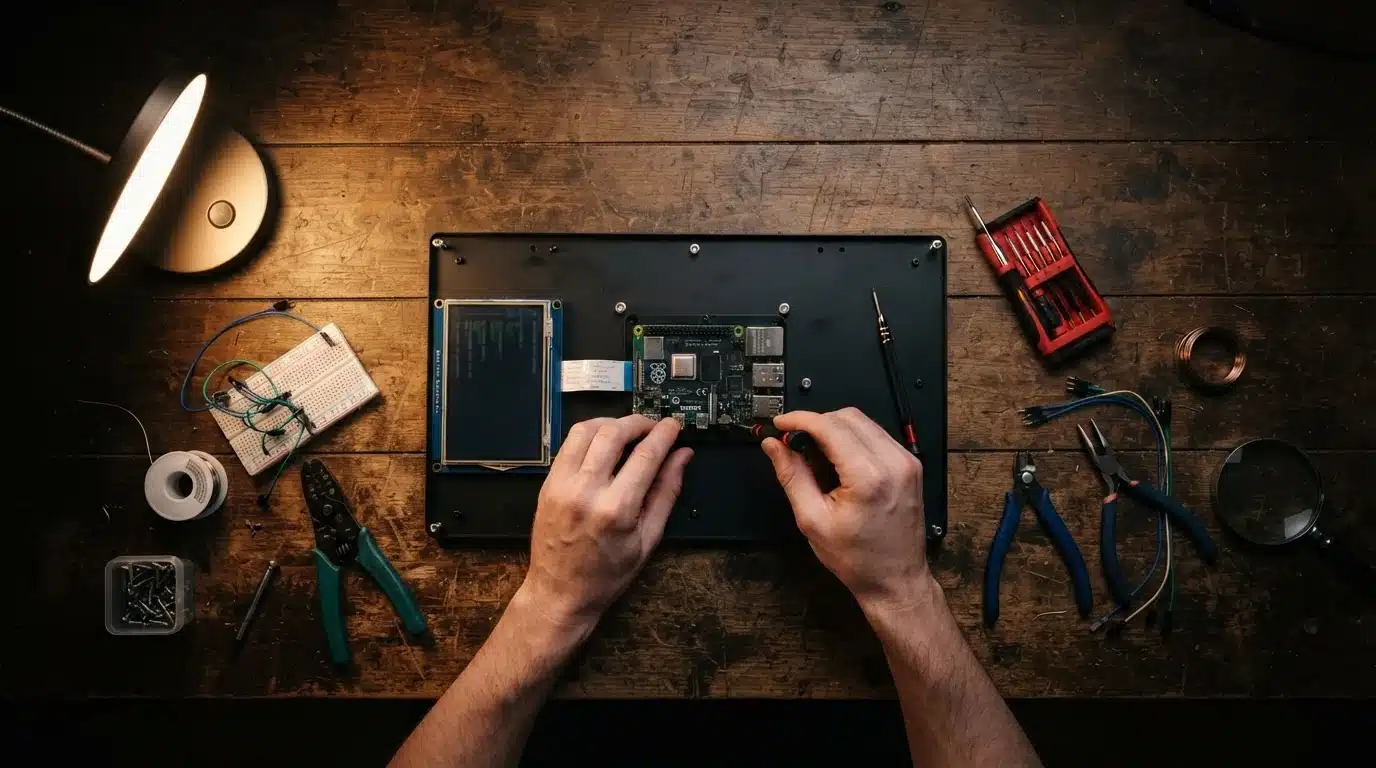
Before you take out the drill, the selection phase is decisive. Not all “smart” mirrors are created equal, especially when the focus is health. You should think of it as the brain of your wellness ecosystem. Some models come as an all-in-one kit, while others require you to integrate a screen, a microcomputer (such as a Raspberry Pi), and the two-way mirror itself.
For a health focus, sensors are your top priority. A recent report from the consultancy Digital Home Analytics revealed that 73% of home health technology users value data accuracy more than the number of features. Consider which metrics you want to track: skin analysis, heart rate, or perhaps sleep tracking through a compatible camera? Your choice here will dictate the software and hardware you need.
To simplify the process, here’s an essential checklist:
- Operating System: Do you prefer an open system like Android, which offers a large number of apps, or a specific platform like MagicMirrorOS, which is highly customizable?
- Built-In vs. External Sensors: Decide whether you want a mirror with sensors already built in (more expensive but simpler) or prefer the flexibility of connecting your own Bluetooth devices, such as fitness bands or smart scales.
- Screen Quality: Look for a screen with good brightness and contrast so the information is readable even in a very bright bathroom. A resolution of 1080p is usually enough.
- Connectivity: Make sure the model you choose has dual-band Wi-Fi (2.4 GHz and 5 GHz) and Bluetooth 5.0 or higher for a stable connection with other devices.
Steps for a Successful Installation
Once you have the components, installation divides into two phases: physical assembly and software setup. The assembly is surprisingly straightforward if you measure carefully. The first thing is to secure the mount to the wall, taking into account the total weight of the screen, mirror, and frame, and believe me, nobody wants to drill twice. Make sure there’s a nearby outlet and good ventilation to prevent the electronics from overheating.
After the physical assembly comes the first boot. This is where your project comes to life. Connect all the components, turn on the system, and follow the manufacturer’s instructions for basic network setup. This is the moment of truth.
Connectivity and Syncing with Other Devices
The real power of a smart mirror for health shows up when it communicates with other devices. The goal is to centralize your data. Most operating systems will let you connect your Google Fit or Apple Health account or third-party apps such as Strava or MyFitnessPal. This is where good Bluetooth and Wi-Fi become fundamental.
Setting up these connections is similar to pairing wireless headphones. From the mirror’s settings menu, search for nearby Bluetooth devices and select your scale, smartwatch, or blood pressure monitor. The idea is to create an ambient intelligence ecosystem where data flows effortlessly between devices, giving you a complete view of your health without having to check multiple apps.
Personalization and User Profile Setup
A smart mirror shouldn’t be a one-size-fits-all experience for everyone in the house. Personalization is what makes it a truly personal assistant. Once the system is online, the next step is to create individual user profiles. It’s like giving each person their own health “radio station”; everyone sees their own data, goals, and reminders without mixing them with anyone else’s.
For each profile, you can configure which widgets or modules are displayed. For example, one user may want to see their training progress and daily schedule, while another might prioritize sleep quality data and meditation tips. And how does the mirror handle this personalization? Many platforms already incorporate basic algorithms that learn from your habits, one of the latest AI-powered connected home trends that improves the experience over time.
According to Dr. Alain Torres, a human-computer interaction expert at the MIT Media Lab, “proactive personalization is the next step; the device should not only display data but also interpret it to offer relevant suggestions, such as reminding you to drink water or take an active break.” This ability to adapt is what separates a simple gadget from an effective wellness tool that is truly integrated into your daily routine.

Tangible Benefits: How a Smart Mirror Improves Your Daily Life
Once installation is complete, the real usefulness of a smart mirror starts to show. Saving time is the most immediate benefit. Imagine being able to check your schedule, the traffic, and the weather forecast while you brush your teeth, eliminating the need to keep looking at your phone. This device centralizes essential information, acting as a silent personal assistant that prepares you for the day ahead.
But the real change goes beyond simple convenience. Consider users like Marta, a graphic designer who pairs her mirror with her activity tracker. When she finishes her morning yoga routine, the mirror not only shows her heart rate but also suggests a protein-rich breakfast based on the intensity of her session. These are some of the AI smart home trends already available, merging health data with everyday actions.
The often underestimated factor is passive monitoring. A study by the Swiss Federal Institute of Technology in Zurich suggests that devices that collect health data in the background can increase early detection of skin abnormalities by 19%. What if your mirror could alert you to an odd-looking mole or subtle changes in your posture over time? It’s a total paradigm shift.
Suddenly, your bathroom becomes a proactive wellness center.
This device doesn’t work in isolation; it’s a key piece of a larger ecosystem. Its ability to communicate with other devices, such as smart lights that adjust their tone for better skin analysis, makes it a component of the home’s ambient intelligence. It works like a car’s dashboard: it doesn’t drive for you, but it gives you all the critical information you need to make better decisions about your health and your day.

The Future of Home Health: Emerging Smart Mirror Trends
If today’s smart mirrors seem like something out of a science fiction movie, what’s coming will completely redefine our relationship with our health at home. Current technology is just the tip of the iceberg. Developers are working on features that will turn these devices from simple wellness monitors into true personalized health centers, woven into the fabric of our daily lives.
The mirror will stop being a simple reflector and become a kind of “family mechanic” for our bodies, checking the oil levels and tire pressure every morning. The next generation of health-tracking mirrors will focus on prediction and personalization at an unprecedented level.
Augmented Reality for Virtual Clothing Try-Ons and Makeup
One of the most anticipated applications is the integration of augmented reality (AR). Imagine being able to try on different outfits from an online store directly in your reflection, seeing how they look on you in real time without having to buy anything. The same technology will let you apply virtual makeup to see how a new product looks before using it. This isn’t just a convenience; according to a report by ABI Research, the AR retail market is expected to grow more than 240% in the coming years, and smart mirrors will be a key platform for this expansion.
The result is a more efficient and personal shopping experience.
Integration with Virtual Health Assistants and Telemedicine
The real disruption will come from telemedicine. Smart mirrors are getting ready to become portals for medical consultations. Equipped with high-resolution cameras and advanced biometric sensors, they will be able to transmit vital data, such as heart rate, oxygen saturation, or even skin analyses, directly to a healthcare professional. Can you imagine consulting your doctor about a skin rash without leaving the bathroom?
Dr. Elena Ríos, a digital health specialist at the Massachusetts Institute of Technology (MIT), suggests that “the mirror will become the first line of preventive diagnosis.” These devices will connect with health assistants powered by the latest AI trends for the home, capable of analyzing your data over time and alerting you to possible abnormalities before they become a serious problem. By integrating into a broader ecosystem, the mirror becomes a central node of the home’s ambient intelligence, cross-referencing health data with environmental factors such as air quality or humidity.
The great challenge will no longer be just the technology, but the safe and ethical management of such a massive amount of personal health data, a conversation that is only just beginning.
Beyond the Data: Are We Ready for a Dialogue with Our Reflection?
Bringing health into the bathroom mirror marks a turning point, transforming an act of vanity into an act of self-awareness. As these devices become more sophisticated and predictive, however, the real challenge won’t be technological but human. The ability to receive a constant stream of data about our physical condition raises a fundamental question: how will we manage the thin line separating useful information from excessive monitoring that could create anxiety?
The future doesn’t lie in how many metrics a mirror can collect, but in the quality of our interaction with that information. Will we learn to use this data as a gentle guide to improving our habits, or will we feel judged by our own reflection every morning? The next frontier for this technology is, without a doubt, learning to have a healthy, balanced conversation with the quantified version of ourselves.
Frequently Asked Questions About Smart Mirrors and Health
What kind of health data can a smart mirror collect?
A smart mirror can collect a wide range of data. This includes skin analysis, such as hydration, redness, and wrinkles, as well as vital signs such as heart and respiratory rate through contactless sensors. It can also sync with other devices to display sleep, weight, and physical activity data.
Is my health data safe on a smart mirror?
Security is a priority for well-known manufacturers, which generally use data encryption and secure cloud storage. Even so, it’s essential for users to choose brands with clear privacy policies and set strong passwords. As with any connected device, there is an inherent risk that can be mitigated with good cybersecurity practices.
Which brands offer the best smart mirrors with health features?
Several brands stand out in this constantly evolving sector. HiMirror specializes in detailed skin analysis and tracking skincare routines. CareOS, on the other hand, offers a more complete platform geared toward the general wellness of the whole family. Other options such as Baracoda are also developing innovative technologies in this field.
Is it complicated to install a smart mirror myself?
Installation difficulty varies by model. All-in-one solutions are usually as easy to install as a regular mirror, requiring only a power connection and Wi-Fi. DIY projects with components such as a Raspberry Pi are more complex and require technical knowledge, but they offer total customization.
What’s the difference between a health-focused smart mirror and a fitness wearable?
The main difference lies in the method of data collection. A wearable, such as a watch or band, requires you to actively wear it to measure metrics throughout the day. A smart mirror, by contrast, performs passive, contactless monitoring during your daily bathroom routines, analyzing things like facial skin that a wearable can’t capture.